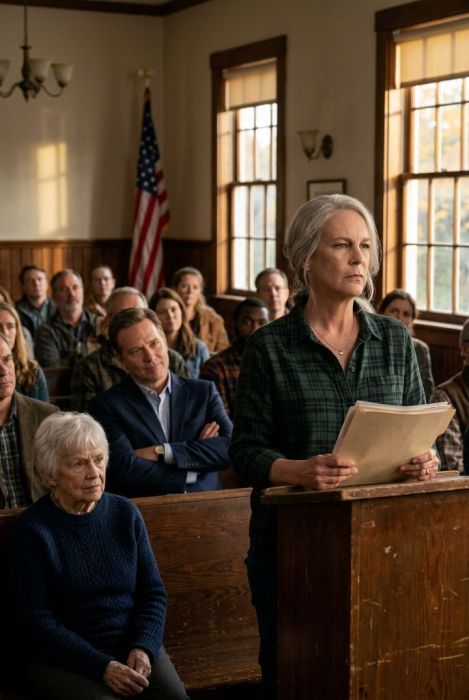
The town clerk read the date on the forged deed out loud, and for one long second the only sound in the hall was the old furnace ticking in the corner.
"September twelfth," Peggy Fontaine said, looking up at me over her reading glasses. "Two-fifteen in the afternoon."
The whole room turned to look at my brother. Dale's smile didn't quite fall, but I saw his hands go very still on his knees.
"The thing is," Peggy went on, gentle as a woman who had carried my mail up to the hospital herself, "Ruth Callahan was in room 214 at the county hospital on September twelfth. I sat with her until visiting hours ended. I signed my name on her cast with a Sharpie." She held the page up for the room to see. "So I'd sure love to know who put her signature on this quitclaim with a notary stamp from Vineland, New Jersey."
The developer's lawyer from Burlington quit smiling first. The rest of the room took a little longer.
That was the night my baby brother tried to sell our family's maple farm out from under me. That was the night he found out that some land doesn't just hold roots. It holds records.
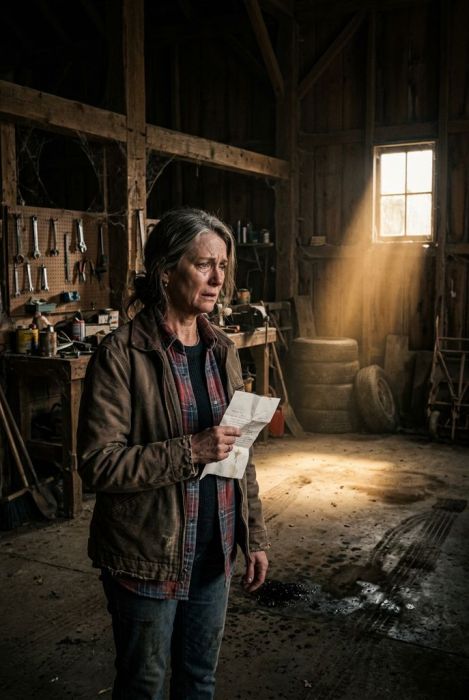
Our farm sits on the east face of Birch Hill, one hundred and fourteen acres of sugar maples my great-grandfather planted. Every spring, my father Walt tapped those trees the way his father did. I grew up with sweet sap under my fingernails and the smell of woodsmoke in my hair.
I was sixty-four last March, and I had spent fifty of those years on that hill. I left once, for a nursing program in Burlington. That lasted eight months, until Dad's back gave out. I came home to help "for a little while," and a little while turned into a life.
Dale, my little brother, was seven years younger. He hated the farm the way some people hate a bad tooth — the cold, the mud season, the undependable money, the way Dad's eyes lit up when he talked about sugar content. Dale sold his first car at sixteen and never looked back. By thirty he was living in Wayne, New Jersey, selling luxury sedans and sending us Christmas cards with return labels on them.
He came home every three or four years, always in a car worth more than our sugarhouse, telling Dad he could get fifty thousand an acre out of a developer "in a heartbeat."
Dad would just laugh and pour him a coffee. "Son," he'd say, "a developer can't make syrup."
Mom was always the one who saw it coming. Evelyn Callahan was eighty-two and sharp as a new tap. "Your brother is a man who loves two things," she told me once, shelling peas on the porch. "Money, and being right. And he thinks he deserves both because the rest of us were too dumb to want them."
Dad passed in April, eight months ago, checking the lines after a late freeze. I found him under the big maple at the top of the hill, the one he'd carved his initials into when he was twelve.
The will was simple, the way Dad was simple. The farm went to Dale and me, split down the middle, with one condition: I had the right to live on it and work it as long as I wanted, and any decision about selling had to be made by both of us together.
What Dad didn't put in the will — because it had been done twelve years earlier — was the easement.
Back in the bad year, when an ice storm took out three hundred trees and syrup prices bottomed out, Mom was the one who said no to a developer sniffing around. She and Dad signed a conservation easement over every acre with the Green Mountain Land Trust. That recorded document said the land could never be subdivided or developed, and never sold without the Trust's approval. In exchange, the Trust paid enough to keep us afloat.
"You're going to curse me for it one day," Mom told me the day we mailed the final copy. "Or you're going to thank me. I can't know which."
I found out which on a Tuesday in September, in a hospital bed, my right hip held together by a plate and seven screws. I'd slipped on the ice carrying a bucket of syrup buckets — ironic, that. The surgery went fine. The recovery was supposed to take six weeks.
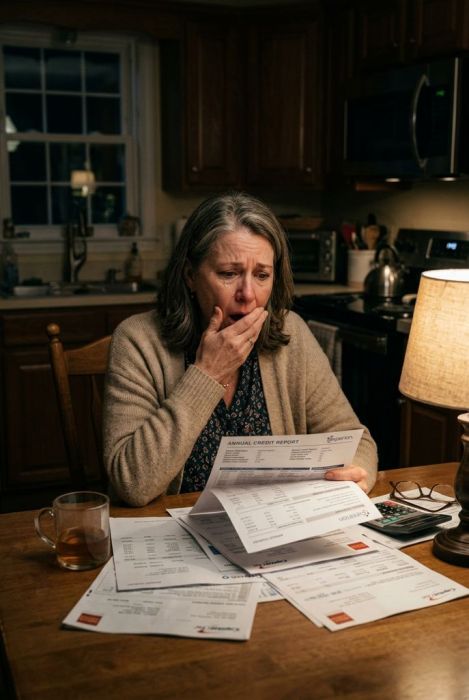
That Tuesday, my phone buzzed with an email that should not have existed. It was from a title company out of Burlington, addressed to Dale Callahan, full of cheerful language about the "pending transfer of the Callahan property" and a "mutual closing date" in three weeks. The buyer was PineRidge Development, LLC. The price was one million four hundred thousand dollars.
I read that email four times. Then I called my mother.
"Mom," I said, "is Dale at the farm?"
"He's here," she said carefully. "He's been here since Thursday. Says he's taking care of things while you're laid up. Had me sign something for the insurance. I didn't like it, so I told him you'd look at it first."
My blood went cold. "What did you sign?"
"I didn't," she said. "I told him you'd look at it first."
I was out of that hospital by Friday, against every doctor's order, with a walker and a careful niece who drove seventy miles an hour. Dale's sedan was in the drive. He had a broker's listing on the place and was telling everyone in town that his poor sister was too broken to manage things anymore.
He came out onto the porch with a smile I'd known since childhood, the one that meant he was about to get what he wanted.
"Ruthie," he said. "You look terrible. Shouldn't you still be in the hospital?"
"You forged my name," I said. No point in dancing. "On a quitclaim. Dated September twelfth. I was in surgery that morning, Dale. I have a cast with Peggy Fontaine's signature on it."
His smile didn't even flicker. "I don't know anything about any quitclaim. I hired a lawyer. I have a document Dad signed giving me full authority over the estate."
"Dad's will gave us equal say. You can't sell without me."
"Ruthie." He said my name like he was talking to a child. "Dad signed a letter in 2019. Notarized. It says I handle the business of the estate, full stop."
Mom's voice came from the kitchen doorway, calm as a church bell in winter.
"Then show it to us, Dale. Your father broke his right hand in the ice storm of oh-one. After that, he always signed with a left slant, and he hated it. I kept every signature book from his desk going back forty years. Show me the letter."
Dale turned to look at her. For the first time, something in his face flickered, like a tree going over in a storm — slow at first, then all at once.
"You always take her side," he said quietly.
"I always take the truth's side," Mom said. "They're usually the same thing."
I had three weeks until the "mutual closing date," and I used every single day of them. That's where Cora Whitfield came in.
Cora was the staff attorney for the Green Mountain Land Trust. "The easement is recorded, Ruth. It's ironclad. It can't be modified by your brother, your father's will, or any letter he waves around. The only way it changes is if the Trust signs a release, and I can tell you right now, we won't."
I asked her the question that had been keeping me up at night. "Then why would a developer put a million four on the table?"
"Because somebody showed them a release," she said. "Somebody gave PineRidge a document that said the easement had been lifted."
Dale had forged more than my signature. He'd forged my father's memory.
The following week, Cora and I went to see Peggy Fontaine, the North Hollow town clerk for forty-one years, who kept records the way other people kept heirlooms.
"He came to see me in August," Peggy said, without me even asking. "Dale. Wanted me to witness something he called a 'family settlement.' I told him I'd need to read it and have a lawyer look at it. He said there wasn't time. That's when I knew enough to say no."
She slid a sheet of paper across the counter. "He left this anyway. Told me to 'hang on to it in case.' I photo-copied it the same day. The notary is a man named Vincent Russo with a P.O. box in Vineland, New Jersey. I called the number on his seal. It goes to a voicemail with a lady's voice, and the mailbox is full."
The trap was simple. I just had to let my brother walk into it.
The town meeting was set for the second Tuesday of October, the same week PineRidge's closing was supposed to happen. The word was out that the Callahan property might be "changing hands," and half the town showed up. The benches were full and people stood along the walls.
PineRidge sent their Burlington lawyer, a man named Marcus Webb with polished shoes and a voice that carried. "Ladies and gentlemen, PineRidge is pleased to announce we've reached an agreement to acquire the Callahan maple farm. Forty-two cabins, a sugarhouse heritage center, and a walking trail system. We have a fully executed purchase agreement, a release of the prior easement, and clear title."
He held up a document with two signatures on it. The room went quiet. I heard Mom shift in her chair in the front row.
Then Cora Whitfield stood up. "Mr. Webb, I'm the attorney for the Green Mountain Land Trust. I'd like to see that release."
Marcus Webb smiled and handed it over. He'd been expecting that. What he wasn't expecting was what Cora did next — she opened her briefcase, pulled out the recorded original easement, and laid both documents side by side on the clerk's table.
"This release purports to be signed by my predecessor, who retired in 2009," Cora said. "It's typed on our old letterhead. The Trust has never authorized a release of the Callahan easement, in whole or in part. I have a certified letter from our director stating as much."
The murmuring started then, low and hungry, the way a crowd gets when it smells a lie.
"That's between the seller and the Trust," Marcus Webb said, but his polished voice had lost some of its polish.
"Oh, it's worse than that," Cora said. "The seller's 'fully executed purchase agreement' relies on a quitclaim deed transferring Ruth Callahan's half of this property. Ruth was in the hospital on the date that deed was signed. Her signature has been witnessed and notarized tonight by the town clerk, who happens to have signed her hospital cast."
Peggy Fontaine rose slowly, holding the forged deed and her own handwritten note from the hospital visiting log. She didn't say much. She didn't need to. She just held it up and looked at Dale.
And then Dale made it worse. He stood up like a man who thought he could still talk his way out.
"That's my sister. She's got mental problems. She fell on her head, not just her hip. Ask anyone."
The room got so quiet you could hear the furnace again.
"Son," said Sheriff Dan Whitcomb, from the back wall, "I've got a warrant here says different. Forgery of a government document, filing false instruments, attempted grand larceny. That PineRidge deposit check you banked last week? The bank's already flagged it."
Dale looked at the sheriff. Then he looked at me. Then he looked at his mother, who sat with her hands folded in her lap — seventy years of syrup and snow and patience in one small woman — and she simply shook her head.
"Vineland, New Jersey, Dale," she said. "You should have at least used a real notary."
Sheriff Whitcomb walked him out through the side door, and the meeting ended early because nobody could decide whether to applaud or just sit there, stunned. PineRidge withdrew the purchase agreement that same night. Their lawyer's parting words were simple: "My client will be pursuing its remedies against the seller. Wherever the seller ends up."
The karma came slow, the way all the best karma does.
Dale's world collapsed all at once. PineRidge sued him for breach and fraud and won the deposit back plus costs. The county brought charges on the forged deed, and the forged "release" went to the state's attorney. His golf-buddy notary in New Jersey sang like a spring robin to save his own skin.
Dale hired a lawyer with money he didn't have, and the money he didn't have turned out to be his townhouse in Wayne, sold at a loss. He spent five months in the county jail — long enough to miss his own daughter's wedding. His wife moved to Florida with the furniture and the dog. His kids stopped taking his calls.
I don't know where Dale is now. Someone said North Carolina, selling timeshares. Someone else said Ohio, driving a delivery van. The details don't matter. What matters is that the farm stayed in the family that built it.
As for me and Mom — the town granted the sugarhouse variance the same night, almost as an afterthought, like an apology from the universe. The following spring, I opened the little pancake house Mom had been describing to me since I was a girl. Twelve tables, windows that look straight out over the sugarbush, Mom's recipe for buckwheat pancakes framed over the counter.
Peggy Fontaine comes for breakfast every Saturday. Even the sheriff stops by, though he says he's just there for the coffee, and we both know that's a lie.
Some mornings, when the light comes through the steam and the whole sugarbush is silver with frost, I think about my father up on the hill, carving his initials into that maple when he was twelve. I think about everything my brother tried to sell, and everything he never understood he was trying to sell.
A developer can't make syrup. My daddy knew that. And now, so does the rest of PineRidge's legal team.
Last Saturday, Peggy Fontaine sat down at her usual table and asked me the question she'd been holding onto all winter.
"Do you ever think about what you'd say to him? If he ever came back?"
I'd practiced it a hundred times, all the ways I'd tell my brother what he'd cost us, what he'd cost himself.
But that morning, with the syrup hot on the griddle and Mom asleep in her chair by the window, I found I didn't have anything left to say to the man who tried to sell my home. So I poured Peggy another cup of coffee instead.
"Tell him the sugarhouse is open," I said. "Tell him the door's unlocked on Saturdays."
"He'd only try to take the syrup," she said.
"He'd have to get past me first." I smiled.
That, right there, is the whole story. Some land doesn't just hold roots. It holds records. And some families, if you're lucky, hold each other.