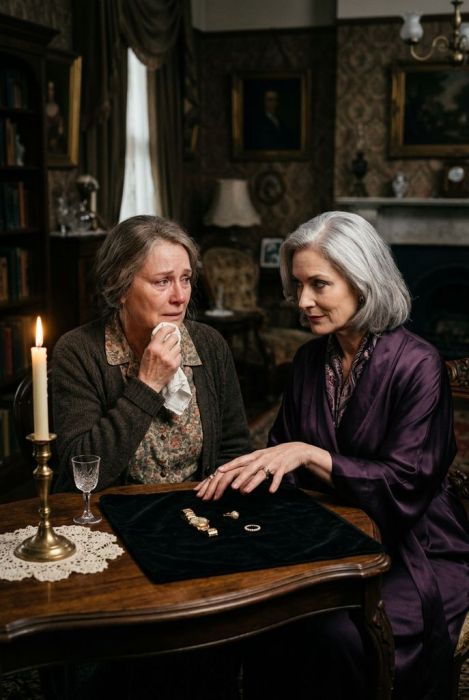
The candles had been burning for two hours when Madame Serena opened her eyes and said Tom was ready to speak. Around the little oak table draped in purple velvet, the other women held their breath. I held mine too, knuckles white around the handkerchief Ruth had pressed into my hands.
"He's here," Serena whispered. "He's standing behind you, Margaret. He wants you to know he feels awful about the roof."
My heart stopped. Tom and I had argued about that roof for nine years, and nobody on our street knew about it except Ruth — and Ruth couldn't be here tonight.
"He says he's sorry he left so fast. He says the canoe is still in the shed, and you should talk to it sometimes. He called you Marge," she added, almost shyly. "Only him. Only him ever."
That was the moment I stopped being a skeptical widow and became a believer. Forty-three years of marriage, and Tom was the only person alive who ever called me Marge. Hearing it come out of a stranger's mouth in a candlelit parlor on the edge of Greenfield undid me completely. I cried into that handkerchief until it was soaked through.
What I couldn't have known, sitting in the lavender smell of that Victorian parlor, was that I was already the main character in a play Ruth had been writing for months. Madame Serena was simply reading her lines.
Tom Hollis died on a Tuesday in May, two days before our anniversary. I found him in the garden among the tomato stakes, his straw hat still on his head. The paramedics said it was a massive coronary, that he wouldn't have felt anything, which I've since learned is what they always tell widows.
Ruth was there the whole time, truly. She was the first person I called and the first through my door; she took charge of the casseroles and the neighbors who didn't know what to say. Ruth had lost her own husband, Dale, five years earlier, so she understood grief. She knew when to sit with me in silence and when to distract me with stories about Dale.
We had known each other since we were girls sharing a locker at Greenfield High in the autumn of 1968. When my Linda was born with colic, Ruth drove through a snowstorm for baby formula. That is why, when she sat me down in my own kitchen and told me about her friend Madame Serena, I listened.
"I know it sounds strange," Ruth said, stirring her coffee. "But Sylvie from church swears Serena helped her find peace. She's not one of those carnival psychics, Marge. She's the real thing. She helped me after Dale, too."
This was news to me. In all our talks five years ago, she'd never once mentioned a medium. But grief makes us hold things back even from our best friends, I reasoned. And I was so tired — bone-tired of the empty bedroom and the untouched fishing rod by the door. If there was a chance, even one in a million, that I could hear his voice again, I would have paid any price.
And eventually, I did.
The first session cost three hundred dollars. Cash, because Serena explained that energy work required a clean exchange and credit cards attracted the wrong vibrations. Ruth sat beside me, holding my hand, nodding as Serena channeled Tom's boyhood dog and finally Tom himself.
The second session cost eight hundred. That time Serena said Tom's spirit was blocked by a sadness I was carrying, and she needed to cut the cord with a ritual requiring white candles, sea salt, and a donation to her temple fund.
The third session cost two thousand, and that one shook me, because Serena produced something that made my blood run cold: a photograph of Tom's mother, Eleanor, standing in front of the old house in Zanesville. I had never shown that photo to anyone outside the family. It lived in a shoebox in the back of my closet; if I'm honest, I'd forgotten I owned it. Serena laid it on the table like a magician revealing a dove. "Eleanor is here," she said. "She wants you to know she's proud of you for coming tonight."
How do you argue with that? I told my daughter Linda that I was feeling much better and she shouldn't worry. "You seem lighter, Mom," she said once, and I preened.
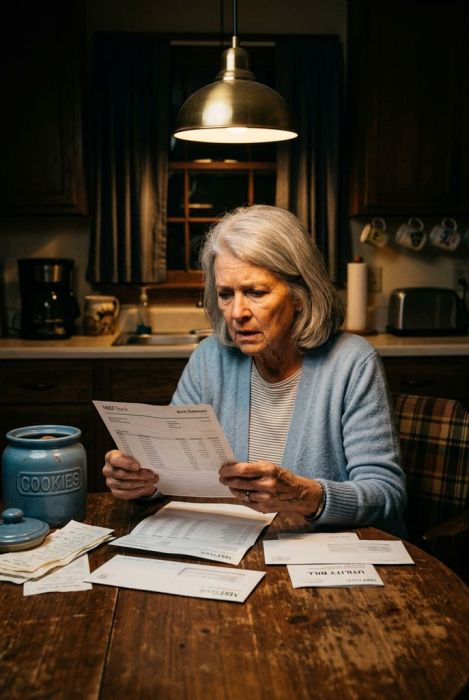
They weren't working. They were draining me. By early September, after the fourth and fifth sessions, I had handed over more than nine thousand dollars — most of the money Tom and I had saved for a roof we would never need. And I was about to write a check that would have cleaned me out entirely.
The sixth session was the one that broke the spell, though I didn't know it yet. Ruth had asked me beforehand, very gently, whether I'd thought about what Tom might need to cross over completely. Serena had raised the exact same idea with me an hour earlier. Ruth was just, as she had always done, helping me understand.
"Tom carried a debt," Serena said, closing her eyes. "From his time in the service. He needs me to perform a release ceremony. The ceremony requires a sacrifice — five thousand dollars, donated to the temple to ease his journey."
Tom was never overseas. He spent two years in the Army Reserve in 1971 driving a supply truck at Fort Leonard Wood in Missouri, but in that moment I didn't catch it. I was too busy imagining my Tom trapped in some gray spirit purgatory because of a debt I could pay. That is the thing about con artists. They don't steal your money. They steal your fear and your love, and they use those to make you hand over the money with both hands and thank them for the privilege.
The plan was that Ruth would drive me to the bank on Friday morning. But I never made it, because Thursday night, Ruth left her phone on my kitchen table — and God forgive me, I picked it up.
It buzzed with a text as I was carrying her coat to the front door. The message was from a contact saved as "Serena," and it read: "She took the bait. The watch is gorgeous — I can get four hundred for it. Push the ring next. Tell her Eleanor wants it cleansed for the wedding in heaven. Then ask for fifteen, not five. She'll pay. She's desperate."
I read it three times, standing in my own hallway with Ruth's coat in my hands, and the floor tilted underneath me. The watch. The ring. Tom's gold watch, the one his father gave him when he made shop foreman. And my mother's ring, the little gold band with the single seed pearl that Tom had slipped onto my finger forty-three years ago. I had told Ruth, in a moment of raw grief, that I'd put both away for safekeeping. I had never told Serena. Yet here was Ruth's phone, buzzing with the plan to take them both.
I did not confront anyone. The old Margaret — the one who believed in forty years of friendship and candlelit parlors — would have called Ruth immediately and handed her the perfect chance to lie her way out of it. That Margaret died in the hallway on Thursday night. The woman who took her place was quieter, colder, and far more patient.
I spent the weekend pretending. I called Ruth on Friday and told her the bank had a hold on my account until Monday. She was so sweet about it, so understanding, and every kind word curdled in my ear. On Saturday I let Serena come to the house. I let her perform her little ceremony with her bundles of sage, and I let her take the watch and the ring, wrapped in a square of black velvet, to carry to the temple for the cleansing. She didn't know I had photographed the whole exchange with my phone propped in the kitchen window, or that I had already called the elder fraud unit at the sheriff's office.
The detective who answered, a brisk woman named Sergeant Dell, listened without interrupting. When I got to the photograph of Eleanor, she stopped me. "She showed you a family photograph from a shoebox in your closet?" Yes. "Has anyone else ever had access to your house?" No one but Ruth. Everyone knows Ruth. Everyone loves Ruth. "That's how these work," Dell said. "The friend is the key. The friend feeds the details, and the medium does the show."
The records confirmed it. Madame Serena was a woman named Wanda Pratt, a former department-store cashier with a string of judgments against her and a closed business called "Heaven's Gate Gifts." Ruth Hanley had a clean record in every database the county had, and that was somehow worse. Ruth wasn't a victim. Ruth was my best friend of forty years, and she was selling my grief to a stranger in a purple dress.
Here is where I have to tell you what I did. I did not rush to the police with the single text, because Detective Dell warned me that one planted message could be explained away. Ruth would say Serena spoofed her phone, or that she'd been helping Serena test a script. I needed Ruth to do something that could not be explained away. I needed her to hand me proof without knowing she was doing it.
So I planted a story, the way you plant a garden. The following Tuesday, at our standing lunch at the diner, I let Ruth pry the big news out of me. I told her my sister in Arizona had asked me to move, and I'd decided to sell the house. I told her I'd found an old safety-deposit box key of Tom's and planned to open the box the next week. I told her the house could fetch two hundred eighty thousand. I watched her eyes go wide and hungry, and I thought, with a coldness I didn't know I had, there you are, Ruth. I see you now.
The lie grew roots fast. By Thursday, Serena called me herself and scheduled an urgent final ceremony for Saturday night. She asked me to bring the deed, so the spirits could bless the new beginning, and fifteen thousand in cash on top of the five we'd agreed on. Ruth drove me, of course. Loyal Ruth, who parked outside and came in to hold my hand, because the spirits always made her nervous.
The ceremony was in the big back parlor with the seven burned-down candles. The other women from earlier sessions were there too, because Serena had announced a grand crossing that would free all their loved ones at once. I recognized Sylvie from the church.
I sat down, and I did the only dishonest thing I have ever done to another human being. When Serena asked everyone to switch off their phones for the spirits, I switched the ringer off and slid my phone, face down, under the velvet cushion at my back, with the voice memo already rolling. Then I said a prayer that Tom would forgive me for using his memory to catch a snake.
Serena worked the room like a revival preacher, and then she turned to me, her face soft and sorrowful. "Tom is here, Marge. He says he's so glad you're selling the house. He loves the idea of Arizona. And he says don't you forget the box at the bank — the little key in the dresser drawer. He wants you to open it on Tuesday, just like you told him." The room murmured in awe. Sylvie gripped my arm. "He really is watching over you," she whispered.
I sat very still, letting the silence stretch until the parlor felt like a held breath. Then I reached behind my back, pulled out the phone, held it up, and pressed play. My own voice filled the room first, small and shaky — the voice of the woman I used to be. Then came Serena's voice, warm and theatrical: "She'll pay. She's desperate." And then, clear as a church bell, the recording of Serena repeating every false detail I had fed to Ruth over pie at the diner. Arizona. The box. The key. The two hundred eighty thousand.
You cannot fake that, and the four widows in that room understood it before I finished explaining. Sylvie went white. "She knew about my husband's toolbox," she kept saying. "Nobody knew about the toolbox." The nervous young assistant bolted for the back door and ran straight into Sergeant Dell, waiting in the garden with two deputies and my daughter Linda, who had driven down from Columbus the moment I called her — my girl had suspected Ruth for weeks and had been too kind to say so.
Ruth was the last to understand. Even in handcuffs, she kept saying she was only trying to help me. "You were grieving," she wept, as the deputy walked her out past the lavender. "I thought you'd be happier with Tom." But the pawn ticket for Tom's watch was in her glovebox, and the ring was in Wanda Pratt's bedroom, in a velvet box with eleven other rings, each with a matching ticket from the same pawn shop. The temple was a post-office box in the next county, and the donations had gone into a checking account with both their names on it.
The charges came down the way the detective predicted: exploitation of a vulnerable adult, theft, and conspiracy, with more charges added when the other families came forward. Wanda Pratt gave the district attorney a full statement to save herself. Ruth's sentencing was the hardest day of my life and also, somehow, the freest. I watched a woman I had loved since we were fifteen stand before the judge, and I felt nothing but a strange, quiet ache for the girl she used to be. An ache. Not a hole. There's a difference.
They returned my watch and my mother's ring at the end of October. I wear the ring again now, on my right hand. Tom's watch I gave to my son on his fiftieth birthday, wrapped in the same black velvet square, because some things deserve a second act that has nothing to do with thieves.
The money came back too — most of it, from the frozen accounts, with interest. I gave a tenth of it to Sylvie's church, and Sylvie and I started a grief support group at the community center, a real one, with a licensed counselor and terrible coffee. We meet every other Tuesday. Nobody there pretends to know what the dead want.
On the first warm Saturday of spring, I dragged Tom's old canoe down to the creek behind the house and paddled out to the deep bend where the bass hide. I sat there in the quiet and talked to him the way I always had. He didn't answer. There was no voice from the water, and for a moment I thought it would break my heart again. But then a turtle slid off a log into the creek with a splash — he'd have laughed at that — and I laughed out loud, alone in a canoe, with tears running down my face, and I understood something I'd been too hurt to see. Tom never needed fifteen thousand dollars to cross over. He was never stuck anywhere but in my grief, and my grief was finally becoming something I could carry instead of something that carried me.
I paddle out to the bend most Saturdays now. And when people ask me how I'm doing, I tell them the truth: I'm doing all right. I lost my best friend of forty years to greed, and the love of my life to time, and somehow, impossibly, I'm doing all right. That's the part of the story I never expected — the part where I get to live it.