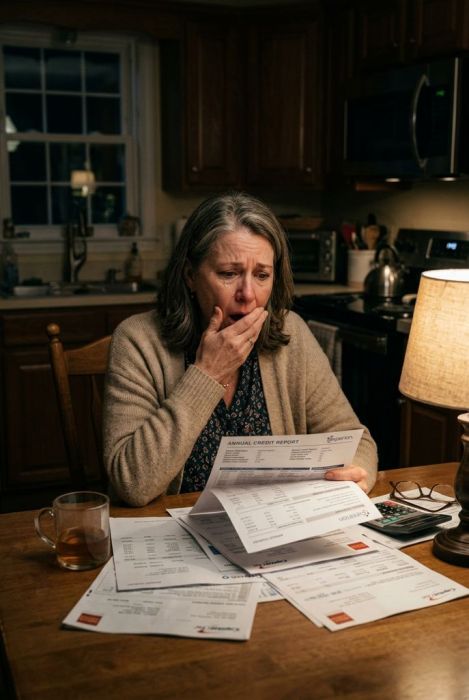
The foreclosure notice arrived on a Tuesday, in the kind of envelope that feels heavy before you even open it. I stood at my kitchen counter drying wineglasses from the previous night's single guest, and when I tore open the seal and read the words, they didn't seem to belong to my life. Past due. Ninety days. Risk of proceedings on the Willow Point Inn.
I had to sit down. This house — this rambling lakeside inn with its peeling white porch rails and the lilac bush Jack planted the summer we opened — was everything to me. It was the dream we'd scrimped for, the place where we raised our daughter, and after Jack died four years ago, it was the only thing that kept me getting up in the morning.
And for the last eight months, it had been dying. Not with a bang — with a whisper. The reservations slowed to a trickle. The phone stopped ringing. The busier the summer got everywhere else in Cedar Lake, the emptier my rooms stayed.
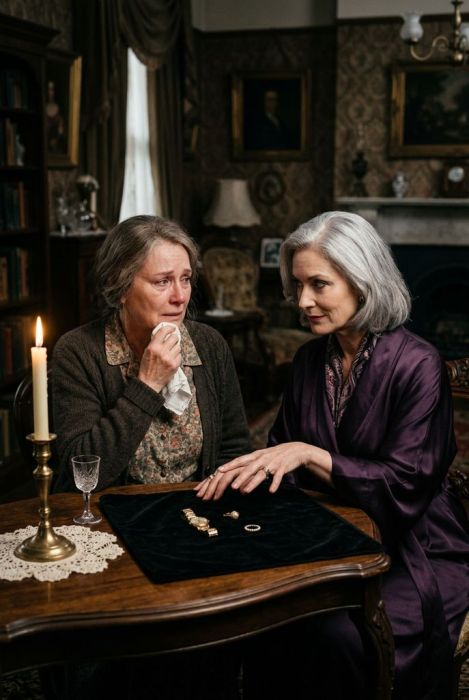
That was when my best friend, Bree Marlowe, arrived at my back door with a covered dish and the kind of sad smile that made me want to cry. "It's going to be okay, Helen," she said, squeezing my hand. "I've been telling you all along. You can't run this place alone forever."
She was the only person I trusted. That was the cruelest part.
Bree and I had been friends since college — forty years, if you counted the early years. She'd stood beside me at my wedding. She'd held my hand when my mother passed. When her own marriage fell apart a decade ago, she moved into the little cottage next door, and I'd been grateful. We had coffee every morning on my porch, shared every heartbreak and every grandchild photo, and I loved her like a sister.
I also gave her the keys to my business. She handled my social media, answered reservation emails when I was elbow-deep in laundry, and she was the one who suggested I switch my booking system to a fancy new website she'd "found a great deal on." I never asked questions. That was my mistake.
The first red flag came in April, in the form of a one-star review that made my stomach drop. "Filthy rooms. Cockroaches in the bathroom. Owner was rude and smelled of alcohol." I read it four times. No guest had ever said those things about the Willow Point Inn — not in thirty-five years, not once.
"People are awful," Bree said when I showed her. "Just delete it, hon. Or better yet, don't even look at them anymore. I'll handle the replies."
I let her. I let her handle everything, because grief had made me tired, and Bree was the one person I believed would never hurt me.
Then the county inspector showed up in May, clipboard in hand, asking about a mold complaint. "We received an anonymous report of black mold in the guest rooms," he said. There wasn't any mold. There had never been mold. But the inspection cost me two days of bookings and a report that said my furnace needed replacing, which I couldn't afford.
My cook of twelve years, Rosa, quit in June. "I'm sorry, Helen," she said, and she wouldn't meet my eyes. "I just... I can't work here no more." When I asked what happened, she only shook her head. Two weeks later, I found out Bree had told her that I was planning to sell and lay everyone off. "I was just trying to prepare her," Bree said, all wide-eyed innocence, when I confronted her. "I didn't know she'd take it that way. I'm sorry. I was only looking out for you."
I hugged her and apologized for snapping. I remember that hug. I remember thinking how lucky I was to have her.
I didn't see them for what they were — a pattern. Fake reviews. False complaints. Frightened staff. One canceled wedding reception. Two honeymoon cancellations. Each one felt like bad luck. Together, they were a targeted attack.
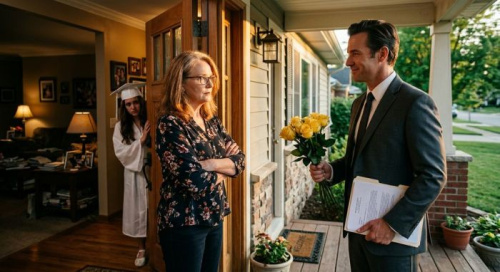
And then, in August, the developer came knocking. A sleek man in a suit from Harbor Development, offering me a number so large I had to read it twice. They wanted the whole lakeside strip — my inn, my land, and Bree's cottage included. "You could retire somewhere warm, Mrs. Vance," he said. "Somewhere without leaking roofs and thirty-five years of memories to weigh you down."
I told them no. I didn't even hesitate.
That night, Bree came over with a bottle of wine and talked to me until midnight about "letting go," about how "Jack wouldn't want you to struggle," about how "you've done enough, Helen, it's time to be taken care of." She was so gentle. So kind. So perfectly, devastatingly convincing.
The bank letter came the next Tuesday. And the Tuesday after that, Bree stood in my kitchen and said the words she'd been circling for months: "Helen, please. Take the offer. Before the bank takes everything from you anyway."
I loved her. I trusted her. And still — something in me went quiet.
That night, I couldn't sleep. I went down to the basement to look for Jack's old toolbox, mostly to have something to do with my hands, and I found a cardboard box I'd forgotten. It was labeled "JACK — SECURITY."
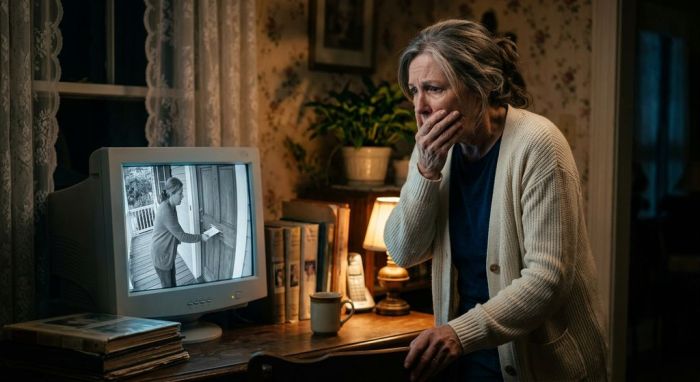
Years ago, before the aneurysm took him, we'd had a small break-in at the inn — a kid stealing the tip jar. Jack had installed a four-camera security system, cheap and old, the kind with grainy footage and a little DVR box that hummed like a refrigerator. After he passed, I'd unplugged it. I told myself it was because I couldn't stand to look at the monitor in his office. But I'd never gotten rid of it.
On a whim, I plugged the DVR back in. The little box blinked awake. And it turned out the cameras still worked — fixed, hardwired, recording onto a disk drive that had been quietly spinning in the basement wall for four years.
I sat down in Jack's old office chair and started scrolling through the footage. It felt like watching ghosts. There was the front porch, the back door, the parking lot, and the office — my office, where I kept the reservation book and the petty cash tin.
And there, on the morning the foreclosure letter came, was Bree.
She was standing at my office desk at 6:40 a.m., before I ever came downstairs, holding my reservation book in one hand and her phone in the other. I watched her photograph pages. I watched her open my desk drawer and take out the stack of receipts I kept in a shoebox. I watched her type something into her phone with a satisfied little smile.
My blood went cold. I scrolled back further — weeks, months.
There she was in April, typing that one-star review on her own phone, sitting in my own kitchen. There she was in May, dropping an unsigned letter into the county mail drop — a letter I later realized was the mold complaint. There she was in June, on the back porch with Rosa, her hand on Rosa's arm, speaking in the low, motherly voice I knew so well. There she was in July, burning a stack of reservation request emails I'd never seen because she'd been deleting them before I woke up.
And there she was, on a Tuesday in August, in the parking lot, in a sleek black car, laughing with the man from Harbor Development. I watched them shake hands. I watched her take an envelope from him.
I watched my best friend of thirty years destroy me, one quiet act at a time.
I didn't confront her that night. I know that's what people expect — the explosion, the tears, the screaming match on the porch. But I'd learned something in sixty-one years of living, and in four years of grief: angry people make mistakes. Quiet people collect evidence.
So I stayed quiet. I bought a new lock for my office. I went through every email, every receipt, every booking I could recover. I found the bank account she'd opened in my name "for shared expenses," with monthly transfers disappearing into it. I found the cancellation fees she'd been pocketing. And I found the contract — right there in her own cottage, through the kitchen window one afternoon — a signed agreement with Harbor Development promising her a six-figure commission the day I signed away my inn.
My heart broke into a thousand pieces. And then, slowly, it turned to stone in the exact right way.
The inn's fortieth anniversary was supposed to be a quiet thing — a few old friends, some of the regulars, a sheet cake. I planned it anyway. I sent invitations to everyone, including Bree. And this time, I invited a few extra guests: the county sheriff, the head of the tourism board, and a reporter from the Cedar Lake Gazette who'd written nice things about the inn when Jack was alive.
I asked my son-in-law, who knew about computers, to set up a screen in the dining room. "For a slideshow of the old days," I told everyone.
Bree arrived early, glowing, wearing the aqua dress she always wore when she wanted to look kind. She helped me set out the napkins. She told me how proud she was of me for finally "facing reality." She was still talking when I tapped my glass and asked everyone to settle down.
"I want to share something special tonight," I said. "A little history of the Willow Point Inn."
The slideshow started with the old days — Jack hammering the porch rail, our daughter's fifth birthday, the summer of the blue herons. People laughed and sighed and said all the sweet things you want people to say. And then the slides ended, and the screen flickered, and the grainy black-and-white footage began.
The room went silent.
There was Bree, in April, in my kitchen, typing on her phone with that satisfied smile. There was Bree at the mail drop. There was Bree on the porch with Rosa. There was Bree in the parking lot, shaking the developer's hand, pocketing the envelope.
And then came the sound — because the old office camera had a microphone, and Jack had never told anyone — of Bree's voice, clear as a bell: "Just keep the pressure on. She'll cave by fall. She's too weak to fight it."
I heard my own name spoken like a punchline.
When the footage stopped, you could have heard a pin drop. Bree was frozen in her chair, the color draining out of her face like water out of a sink. She opened her mouth. Nothing came out.
"I trusted you," I said, and my voice only cracked once. "For thirty years, I trusted you. And you signed a contract to sell my home out from under me."
The sheriff stepped forward. The tourism board head held up the forged complaint. And the reporter's pen never stopped moving.
It all came out at the trial. The embezzled deposits. The forged reviews. The false complaint filed under a fake name, which is a crime in itself — plus identity fraud and a dozen smaller charges that stacked up like dominoes. Bree cried. She apologized. She blamed her divorce, her loneliness, the fact that she'd loved Jack first and never gotten over it, forty years later.
That was the part that almost undid me. She'd been carrying that jealousy for four decades. She'd smiled at my wedding while hating me for it, and when Jack died and I was vulnerable, she saw her chance to take the only thing of his that was left — the home we built together.
The judge didn't care about her broken heart. Neither did the jury. Bree Marlowe was convicted of fraud, forgery, and embezzlement, and she went away for a long time. She lost her cottage, too — mortgaged to the hilt against the developer's promise, which evaporated the moment the newspaper hit the stands.
Harbor Development pulled out of Cedar Lake within a month. Nobody in town would sell to a company tangled up in that kind of story.
As for me — well. The town showed up. That's the thing I still can't talk about without tearing up. The Gazette ran the story, the phone started ringing, and people who'd read about the kind woman whose best friend tried to steal her inn started booking rooms just to shake my hand. The anniversary of the inn became a real celebration, three weeks late, with every room full and a line out the door.
The bank called me in October — not about the foreclosure, but to ask if I'd like to extend my credit line, because the Willow Point Inn had just had its best season in years.
I keep the plants on my porch thriving. I keep the lilac bush pruned. And yes — I kept the old security system. It's humming in the basement right now, in Jack's memory, above the door he built with his own hands.
Some nights, when the inn is quiet, I sit in his office and I talk to him. I tell him we made it. I tell him that the truth always has a way of surfacing, even when people think they've buried it. And I thank him — for the camera, for the home, and for never leaving me without a way to fight back.
My best friend of thirty years tried to take everything I had. Instead, she gave me the two things I needed most: proof, and freedom. And on the mornings I drink my coffee alone on the porch, watching the sun come up over the lake, I don't feel like a victim. I feel like the luckiest woman in Cedar Lake.