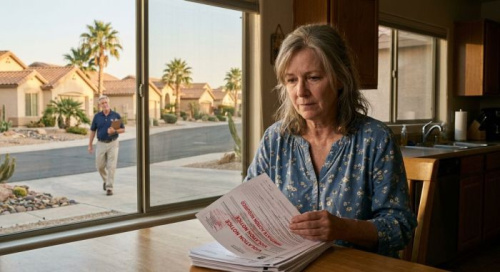
The postcard arrived in a Tuesday pile of bills and catalogs, and Margaret Delaney almost threw it away with the rest. But the photograph on the front stopped her cold — the old Willow Creek High School, the one with the bell tower that came down in 1991 to make room for the new building. Beneath the picture, in cheerful blue letters: CLASS OF 1975, 50TH REUNION. And beneath that, in smaller type, a line that made her heart do something strange: Time Capsule Opening to Follow Dinner.
Maggie stood at her kitchen counter in Columbus, Ohio, holding the postcard in both hands, and felt a sensation she couldn't quite name. It wasn't exactly nostalgia. Nostalgia was safe and pleasant, something you could hold at arm's length. This felt more like a door creaking open in a room she'd forgotten she'd locked.
She hadn't been back to Willow Creek since her mother's funeral in 1998. Twenty-seven years. The town had stayed frozen in her mind the way it was in the summer of 1975 — the smell of cut hay, long shadows on Maple Street, the screen door at Lou's Diner slapping shut behind a line of teenagers.
The postcard was signed by Ruth Ann Kowalski, whose married name was now Rutledge. Ruth Ann had been her best friend since third grade, the kind of friend who kept your secrets like a savings account. They had drifted after Maggie moved to Columbus for college, the way people do, each year of silence making the next one easier.
Her husband Daniel had passed six years ago. She missed him every day, but she had learned to live with the missing — to cook for one, to watch the evening news alone, to fill the quiet with books from the library where she'd worked for thirty-one years. Her daughter lived in Chicago and called every Sunday. It was a good life. A quiet one.
So why was she standing at six o'clock on a Tuesday evening, reading a postcard about a fifty-year reunion three times?
Because buried in that small blue envelope of memory was a name she hadn't let herself think about in decades. Tom Baker. Tom, who had sat behind her in Mrs. Hanrahan's history class and passed her notes folded into paper airplanes. Tom, who had fixed her bicycle chain the summer before junior year and never once mentioned the grease on his hands. Tom, the first person she had ever told her secrets to, and the last person she'd spoken to at the graduation picnic.
And that was the part that hurt. The last time she saw him, she had been heartbroken, and too proud to show it, and she had handled it the way seventeen-year-olds handle heartbreak. She had pretended not to care.
She remembered the prom like it was yesterday, which was strange, because she couldn't remember what she'd had for lunch that day. May 1975. Ruth Ann had let it slip that Tom was going to ask her — he'd been saving up for a corsage, and she wasn't supposed to say a word. Maggie had spent two weeks imagining it. But the night of the prom came and went, and Tom never asked. She'd stayed home and listened to her parents argue about the grocery bill and told herself she didn't care.
Then, at the graduation picnic in June, she'd seen him under the old oak tree with Sandy Whitfield, heads close together, Sandy's hand on his arm. Something had closed in Maggie's chest that day, something that didn't reopen for a long time. She'd been polite to him all afternoon, cool and bright as glass, and when he'd tried to talk to her — Maggie, hey, I've been meaning to say something — she'd smiled and said, Looks like you found your date after all, and walked away.
He'd called after her. She didn't turn around. She'd told herself that was dignity, and she'd told herself that for fifty years.
The truth, which she'd carried in her back pocket like a smooth stone, was that she never stopped wondering what he'd been about to say. She'd built a whole life on not knowing.
She called Ruth Ann that night. The phone rang twice before a familiar voice, older but unmistakable, said, "If this is a telemarketer, I'm hanging up."
"It's Maggie. Maggie Delaney."
A beat of silence. Then: "Margaret Delaney, you get off my phone and get on a bus. I've been waiting thirty years to hug you."
They talked for an hour. Ruth Ann told her about the grandkids, the hip replacement, the community garden. Maggie told her about Daniel, about Chicago, about the quiet. And then, gentle as a hand on her shoulder, Ruth Ann said, "Tom's coming, you know. He's a widower now. Lost Carol three years ago."
Maggie was quiet for a long moment. "I'm sorry to hear that."
"He lives out on the old Baker place. Took over the farm when his daddy passed. Does furniture restoration now, out in the barn. Makes beautiful things." Ruth Ann paused. "He asked about you, once. At the fortieth, he asked if you were coming."
"I didn't come to the fortieth."
"I know. He looked at the door all night anyway."
Maggie closed her eyes. She could feel the shape of that sentence like a key in a lock. "I'll be there, Ruth Ann. I'll come home."
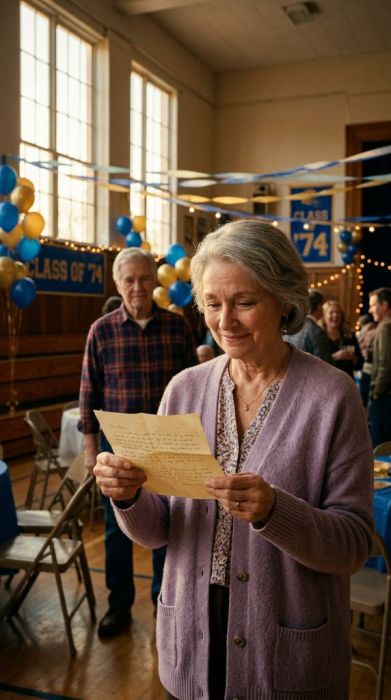
The reunion was held at the Willow Creek Community Center, a brick building that used to be the old high school gymnasium. Balloons in the school colors — blue and gold — bobbed against the ceiling, and a banner stretched across the stage: Welcome Back, Class of '75. The air smelled like coffee and hairspray and something sweet from the caterer's table.
Maggie walked in and was swallowed by warm hands and familiar faces. There was Bobby Greer, bald now, still laughing at his own jokes. Nancy Phillips, who had kept every playbill from every school play. Mr. Delvecchio, their old biology teacher, ninety years old and still telling everyone that the mitochondria was the powerhouse of the cell. It was like stepping into a photograph and finding the people inside were still alive, still talking, still glad to see her.
And then she saw Tom.
He was standing by the punch table, older and grayer, his shoulders a little softer than they'd been at eighteen, but it was him. The same kind eyes. The same way of holding his cup with both hands, like he was warming them. He looked up, and their eyes met across the gym, and for a moment neither of them moved.
He raised a hand. She raised hers. And that was all — but it was more than she'd had in fifty years.
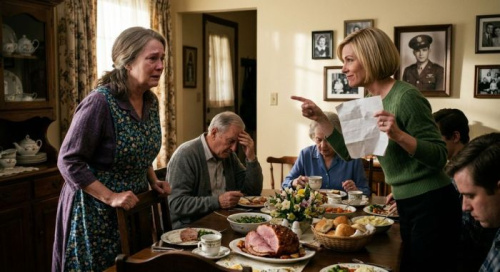
The dinner was long and warm and full of laughter. Speeches were made. People were remembered — the ones who hadn't made it to fifty years, whose names were read in a quiet voice, and the room held its breath together the way only people of a certain age know how. Then the principal of Willow Creek High, a young woman named Principal Ortiz, wheeled in something that made the whole room lean forward.
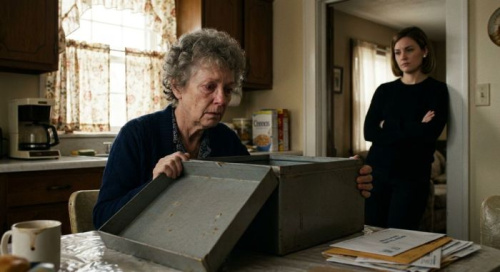
The time capsule. A dented metal box that had been buried in front of the old schoolhouse in June of 1975 and dug up only that spring, when they'd redone the parking lot.
Principal Ortiz lifted the lid, and the room sighed. Out came a yearbook, a cassette tape, a stack of photographs, a copy of the school newspaper — the headline read SENIORS VOTE FAVORITES. And letters. Dozens of letters, sealed in envelopes, each addressed to the student who had written it, in handwriting that had been waiting half a century to be read.
The letters were passed out like treasures. There were gasps and laughs and a few wet eyes as people opened themselves at seventeen.
And then Principal Ortiz reached into the box and pulled out one last envelope. It was plain white, yellowed at the edges, and it wasn't addressed like the others. The handwriting on the front made Maggie's heart stop.
Margaret Ann Delaney.
"Well, well," someone said. "Looks like somebody's got a secret admirer."
Ruth Ann looked at her with wide eyes. And across the table, Tom Baker had gone very still, his fork halfway to his mouth, a strange expression on his face — surprise, and something else, something like a man watching a door he thought was locked swing open.
Maggie's hands trembled as she opened the envelope. Inside was a single page, folded twice, dated June 7, 1975 — the day of the graduation picnic. Written in Tom's careful, rounded hand.
Dear Maggie, it began. I've been trying to write this for two months.
The letter explained everything. He had meant to ask her to the prom. He'd bought the corsage and hidden it under his bed. But his father had a heart scare in April, and Tom had spent prom night at the hospital with his mother and his sisters, and his father had made him promise not to tell anyone — it was going to be fine, the doctors said so, and he didn't want the whole town fussing. By the time things settled down, the prom had come and gone, and Tom had figured she was mad at him, and he didn't know how to explain without breaking his father's confidence.
Then at the graduation picnic, he'd seen her talking to a tall dark-haired boy, and she'd looked happy, and he'd decided he'd missed his chance. So he'd written this letter instead, planning to give it to her before she left for college. But he'd chickened out. And when he'd seen the time capsule committee's box sitting open, waiting for donations, he'd slipped the letter inside, telling himself it was romantic. A letter that would wait fifty years. He'd told himself that if it was meant to be, she'd find it.
If you're reading this, I hope you had a good life, Maggie, the letter ended. I hope somebody loved you the way I wanted to. I want you to know I tried. I was just too scared to say it out loud. — Tom
Maggie read it twice. Then a third time. The room had gone quiet around her, the way rooms do when everyone understands something important is happening.
She looked up. Across the table, Tom was watching her, and she saw something in his eyes she hadn't seen since 1975 — hope, and fear, and a question he was too old to ask and too young at heart to stop himself from hoping.
She stood up. Her legs carried her around the table, past Ruth Ann's outstretched hand, past Nancy Phillips's open mouth, until she was standing in front of him.
"The tall boy at the picnic," she said, and her voice came out smaller than she meant it to. "That was my cousin Eddie. He came up from Cincinnati for the weekend. He had a crush on Ruth Ann."
Tom stared at her. "Your cousin."
"My cousin." She laughed, and it came out half a sob. "I spent fifty years thinking you chose Sandy Whitfield."
"Sandy Whitfield." Tom said her name like it was a joke he couldn't quite believe. "Maggie, Sandy was crying her eyes out that day. Her boyfriend had just joined the navy, and she asked me to help her write him a letter. I never even liked Sandy." He shook his head slowly. "I spent fifty years thinking you chose somebody else."
"I didn't choose anybody else." She heard herself say it, and it was the truest thing she'd said in decades. "I just didn't know I had a choice."
For a long moment, nobody in the gymnasium moved. Then Ruth Ann, who had been openly weeping into a napkin, let out a sound that was half laugh, half wail, and somebody started to clap. Then somebody else. Then the whole room was on its feet, clapping and laughing and hooting like they were seventeen again, and Principal Ortiz was wiping her eyes with the back of her hand, and Maggie was laughing and crying at the same time, standing in a gymnasium full of people she'd known her whole life, holding a letter that had waited fifty years to reach her.
Tom reached out and took her hand. "Maggie Delaney," he said, "do you still drink strawberry milkshakes?"
"I haven't had one in fifty years," she said. "I've been waiting for somebody to ask."
Lou's Diner was still there, at the corner of Maple and Second, unchanged except for a fresh coat of paint and a sign that said EST. 1948. Lou himself had passed in the nineties, but his granddaughter Jean ran the place now, and the milkshakes were still made the old way, thick enough that the straw stood up on its own.
They sat in a booth by the window, two strawberry milkshakes between them, and talked until Jean finally flipped the sign to CLOSED and then sat down with them anyway, because that was the kind of place it was. Tom told her about the farm and his daughter in Boise and the walnut dressers he restored in his barn workshop. Maggie told him about Daniel, about her granddaughter who played the violin, about thirty-one years of helping people fall in love with reading.
At some point, the conversation drifted to the letter. "You really put it in the box," Maggie said. "You really thought I'd find it in fifty years."
"I was seventeen," Tom said, with the closest thing to embarrassment she'd ever seen on him. "I thought it was romantic. Like something out of a movie."
"It was." She stirred her milkshake with a straw. "It was the most romantic thing anyone ever did for me."
Tom was quiet for a moment. Then he said, "Fifty years is a long time to wait for a milkshake."
Maggie smiled, and it felt like the first real smile she'd smiled in a long time. "It was worth it."
Outside, the streetlights came on over Willow Creek, and Margaret Delaney, who had come home for one night — for a postcard and a dented metal box and a letter that had waited half a century — discovered that some doors don't creak open by accident. Some doors, it turns out, have been waiting all along for you to come back and turn the handle.