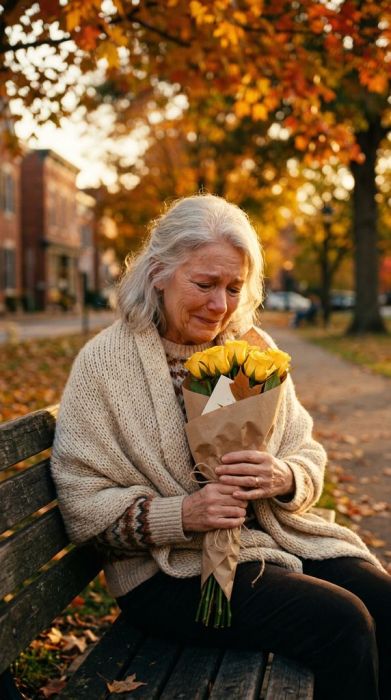
June Hartley first noticed the roses on a Tuesday, which felt right somehow, because Tuesdays had always been their day.
She was sixty-eight years old, five years a widow, and she had learned to measure her life in small ceremonies. Coffee at the same booth at Mabel's Diner every morning, the crossword on Wednesdays, and the walk to Willow Creek Park every October twelfth — the anniversary of the day Tom Hartley sat down beside her on that old wooden bench and asked if she minded the company.
She minded. She said so, too, in her brisk twenty-two-year-old way. And he laughed — that easy, generous laugh she would hear for the next forty-three years — and said he'd wait until she changed her mind.
It took him eleven minutes.
The roses were already there when she arrived that year, a small bunch of yellow ones wrapped in brown paper and tied with plain kitchen twine, resting on the bench where Tom used to sit. There was no card, no note, no ribbon. Just roses, bright as a patch of afternoon sun against the gray October wood.
June stood very still. Then she sat down in her spot, gathered the roses into her lap, and cried a little — the good kind of crying, the kind that felt less like grief and more like being remembered.
She assumed it was one of her daughters, or her sister Carol, who had always been sentimental in that sneaky way. But Carol swore she hadn't, and both daughters swore the same, and nobody knew anything about yellow roses on a park bench.
"Maybe it's the park service," her daughter Kate suggested. "A memorial thing."
But the park service did not wrap roses in brown paper and twine. June knew this because she asked. She asked everyone, in her quiet, thorough way. The florist had never delivered them. The neighbors on Maple Street had seen nothing. The mystery of the yellow roses joined the small, comfortable store of wonders in Willow Creek — a town where the biggest scandals usually involved the Harvest Fair pie contest.
The next October twelfth, the roses were there again. Same bench. Same brown paper. Same twine.
And the year after that. And the year after that.
By the fifth year, June had stopped calling it a mystery and started calling it a ritual. She had made one of her own, too. She brought two cups of coffee in the old green thermos, poured one for herself and one for the empty space beside her, and sat with the roses until the sun went down. She talked to Tom the way widows do when they're sure no one is listening. She told him about the grandchildren, about Kate's promotion, about the robin that had built its nest on the porch light three springs running.
It was a good hour. Maybe the best hour of her year.
But this October, something had shifted. This October, she decided she needed to know.
"I'm going to find out who leaves those roses," she announced at breakfast, to no one in particular, because she lived alone now and the cat did not care.
Her cat, Biscuit, blinked at her from the windowsill.
"I mean it," June said. "Five years is long enough to be grateful. It's time to say thank you."
So she made a plan. It wasn't much of a plan, but it was hers.
On the night of October eleventh, June Hartley — retired school librarian, sixty-eight years old, not spry but still plenty stubborn — packed a folding chair, a thermos of coffee, her grandmother's wool shawl, and a flashlight, and settled herself behind the big rhododendron bush near the bench in Willow Creek Park.
She arrived at four in the afternoon. The roses never appeared before dusk, so she reasoned she had time. She brought a book, a cozy mystery about a librarian who solved crimes, but she couldn't concentrate. Her heart was doing something unfamiliar. It was fluttering, the way it used to when she was a girl waiting for something good.
Twilight came, purple and soft. The park emptied out. The streetlights came on, one by one, like someone lighting candles down a hallway.
And then, at a little after seven, she saw him.
A figure came up the path from the direction of the creek — an older man, thin, with a slight stoop and a flat tweed cap pulled low. He walked slowly, the way people walk when they aren't in any hurry to be anywhere. In one hand he carried a small bundle wrapped in brown paper.
June's breath caught.
The man reached the bench. He stood there a moment, looking at the spot where Tom used to sit. Then he set the roses down, gently, as if they were something precious, and straightened up.
He touched the brim of his cap. A small gesture. Almost a salute.
And then he turned to go.
"Wait," June said. Her voice came out scratchy from hours of silence. "Please. Wait."
The man froze. For a long moment he didn't turn around. Then, slowly, he did.
The streetlight caught his face. He was older than she'd expected — mid-seventies, with kind, tired eyes and a face full of quiet weather. He looked, June thought, like a man who had been caught doing something he was a little ashamed of and a little proud of, all at once.
"I'm sorry," he said. "I didn't mean to startle you."
"You didn't startle me," June said, climbing out from behind the rhododendron with as much dignity as a woman in a wool shawl and sensible shoes could manage. "I've been waiting for you. For five years, actually."
The man's eyes widened. "Five years?"
"Five years," June confirmed. "October twelfth, every single year. Yellow roses on that bench." She studied him. "You're Samuel Oakes, aren't you? From the post office?"
Something in his face relaxed, just a little. "Retired now, but yes. Folks call me Sammy."
June knew Sammy Oakes. Everyone in Willow Creek knew Sammy Oakes. He'd carried mail on the east side of town for thirty years, quiet and dependable, the kind of man you noticed without really noticing. He'd been at Tom's funeral, she remembered now. He'd stood in the back, cap in hand, and hadn't said a word.
"Why?" June asked. It came out softer than she meant it to. "Why the roses, Sammy? Why every year?"
Sammy looked down at the roses. When he looked up, his eyes were bright.
"Because I made a promise," he said. "The day your husband died."
And then, in the lamplight, with the creek running soft behind them, Sammy told her a story June had never heard.
Thirty years ago, Sammy Oakes had been a different man. His wife had left him. The bank had taken the house on Grove Street. He'd spent six months sleeping in the back room of the feed store, telling himself he'd get back on his feet any day now. Some mornings, he said, he didn't see much point in getting up at all.
Tom Hartley had found him one cold March morning, sitting on the loading dock behind the hardware store with a bottle in a paper bag and no fight left in him. Tom hadn't lectured him. He hadn't preached or shaken his head the way other folks did. He'd just sat down beside him — the way he'd once sat down beside a young woman on a park bench — and said, "I've got a job needs doing, if you're of a mind."
"I told him I wasn't worth the trouble," Sammy said. "I told him I was a lost cause, that everyone knew it."
"What did he say?" June whispered.
Sammy smiled a little. "He said, 'Everyone's a lost cause until somebody finds 'em.'"
Tom gave him the job. He gave him an apron and a key to the back door and a reason to get up in the morning. He never asked about the bottle, never mentioned the house or the wife. He just kept showing up, kept trusting Sammy with the inventory and the keys and, eventually, with his friendship.
"I got clean," Sammy said. "I got my job back at the post office. I got my life back." His voice caught. "I owed him everything. And he never once let me pay him back."
June was crying now, and she didn't bother to wipe her eyes.
"The day he died," Sammy went on, "I went to the hospital. I wasn't family, but they let me in anyway — he'd asked for me, can you believe it? And he was sitting up in that bed, thin as a rail, and he said, 'Sammy, I need you to do me a favor. A big one.'"
Tom had known he was going. He'd made peace with it, the way he'd made peace with everything. But there was one thing he couldn't stand — the thought of June sitting alone on that bench every October twelfth, the day they'd met, with nobody to mark it. The day they met was the day he'd want her to remember, not the day he'd left.
"He told me to bring yellow roses," Sammy said. "They were your favorite. He remembered you telling him that at the county fair, the summer before he passed. He said if I'd bring the roses, you'd know you weren't forgotten. That's all he wanted. For you to know you weren't forgotten."
June pressed a hand to her mouth.
"And the porch step?" she managed. "The winter the step rotted through? And the firewood that showed up the year the mower broke?"
Sammy's face went red. "I — well. That was mostly me."
"Mostly you?"
"With help," he admitted. "The firewood was Pete Miller. The mower was fixed by the high school shop class, though they'd never admit it. And the porch step..." He looked at his shoes. "That was me and my nephew, one Saturday morning before you were up. I told the whole town about the roses, you see. Seemed only fair they should know. And folks just started helping. Quiet like. The way folks in Willow Creek do."
June let out a sound that was half laugh and half sob. "Everyone knew? The whole town?"
"Not everyone," Sammy said quickly. "But a good many. Your sister Carol helped me pick the roses the second year. She made me swear I'd never tell you. Said you'd cry, and she'd never hear the end of it."
June sat down hard on the bench, the roses still in her hands, and for a moment she couldn't speak at all. Five years. Five years of wondering who remembered, and the whole time it had been Tom — Tom and Sammy and Carol and a dozen quiet neighbors, all of them holding a candle to the dark so she wouldn't have to sit in it alone.
She heard footsteps then, soft on the path, and looked up.
Carol was coming down the lane with a lantern, and behind her came Kate with the grandchildren, and Pete Miller, and Mabel from the diner carrying a pie in both hands, and the shop teacher from the high school, and half the people June had known her whole life. They came quietly, the way they'd been coming for years, and they gathered around the bench in a loose, warm ring of lamplight.
"You watched me," June said, her voice breaking. "All of you. All these years."
"We didn't watch you, honey," Carol said, setting the lantern down and taking her sister's hand. "We kept you company. From a distance, is all. Tom asked us to."
Sammy sat down on the bench beside her — on Tom's side, June noticed, and it seemed exactly right. "He asked a lot of us, that man," he said softly. "But that was his way. He couldn't stand the thought of anybody being alone. So he made sure nobody was."
They stayed on the bench a long time, the whole gathering of them, passing Mabel's pie around on paper plates and telling stories about Tom Hartley — the time he'd talked the bank into lending Pete Miller the money for his tractor, the year he'd dressed as a turkey for the Harvest Fair parade, the way he'd never once lost his temper at the high school kids who hung around the hardware store after school. June laughed and cried and laughed again, and somewhere in the middle of it, she realized the grief she'd been carrying for five years had quietly changed shape.
It was still there. It would always be there. But it had turned into something she could hold, instead of something that held her.
When the last of the neighbors had gone home, June and Sammy sat together on the bench with the thermos between them. She poured him a cup of coffee, and he told her about Tom's last days — the jokes he'd made, the names he'd called the hospital food, the way he'd made Sammy promise to keep an eye on her "whether she likes it or not."
"He said you were the stubbornest woman in three counties," Sammy said, grinning. "And that he'd want it that way."
June laughed. "He wasn't wrong."
The next October twelfth, June arrived at the bench with two cups of coffee and found Sammy already there, a fresh bunch of yellow roses in his lap.
"I thought maybe we'd share them this year," he said, a little shyly.
She sat down beside him and handed him his coffee. "I think that's exactly what he'd want."
And that was how the Tuesday table began — breakfast at Mabel's, every Tuesday, for the two of them. Somewhere along the way, June started a book club at the library, and Sammy became her first and most faithful member. They weren't a romance, exactly. It was something quieter and just as dear — two people who had been found, sitting together in the warm light of a promise kept.
The roses were never about saying goodbye, June finally understood. They were about being found. And every year, when October rolled around and the leaves turned gold, she walked to the bench with two cups of coffee and a heart full of the same gentle wonder.
Tom had left her the best gift a man could leave a woman. He had left her a town full of people who remembered, and a promise that she would never have to sit alone again.