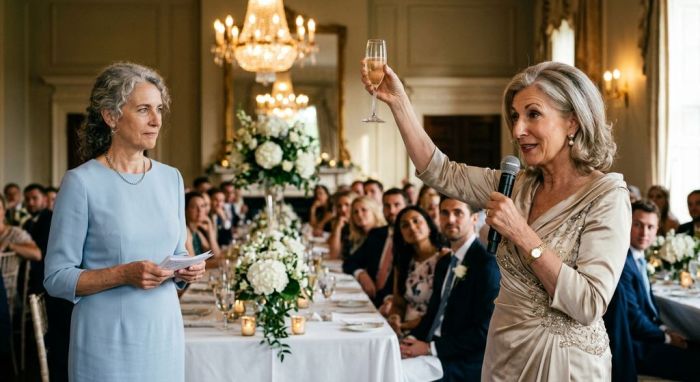
At my only daughter's wedding, the mother of the groom stood at the microphone and claimed the entire evening as her triumph. She thanked her husband for his generosity, named the historic venue as if she had chosen it straight from a magazine, and asked everyone to raise their champagne to "the people who made tonight possible." Then her eyes found mine across the candlelit room, and she smiled the way a cat smiles at a cornered mouse.
My name is Ruth Calloway. I am sixty-one years old, and for the past nine months I have been the quiet punchline of Evelyn Hartley's very expensive joke. She never said it out loud, of course. Evelyn was far too polished for that. But I heard it in every "how kind of you to come early and help," every time she corrected how my daughter's napkin should be folded, every "bless your heart" that landed on my modest shoes like a small, sharp stone.
My daughter Mia was marrying Grant Hartley, the only son of one of the wealthiest families in our corner of Connecticut. They had met at a small gallery downtown, where Mia worked as a curator and Grant had wandered in off the street, bored and looking for something to do on a rainy afternoon. He was kind to her, genuinely kind, which was the only thing that mattered to me. But his mother had a different idea of what a bride's family should look like, and I did not fit the photograph she had already framed in her head.
I should tell you something about myself, so you understand why I let her walk all over me for so long. I am not poor. I own the Larkspur House, the very venue where this wedding was being held — a Georgian estate that has been in my family for three generations. But I did not dress like it, and I did not talk like it, and I did not advertise it. I had learned a long time ago that the quietest people in a room often own the roof over everyone's heads. My late husband used to laugh and call our life "loudly modest." We drove a ten-year-old station wagon, wore sweaters with small mended elbows, and saved every extra dollar for our daughter's future. That was our quiet rebellion against the world Evelyn lived in.
Mia knew what I owned. I had told her the moment she started planning, because a mother should never hide the truth that gives her child a place to stand. "Mom," she had said, squeezing my hands, "let's let them think whatever they want. I just want my wedding to be beautiful, and I want you there."
That first planning meeting was where the trouble began. Evelyn arrived forty minutes late, swept into the room in a cloud of perfume, and declared that she would be "handling the details" because a wedding of this magnitude was "not really something everyone knows how to do." She looked at me then, quickly, as if checking that I knew I was the "everyone" she meant.
She went on for an hour. The venue, she said, was "charming, if a little tired," and she had already spoken to a property manager about updating the hydrangeas. The caterer she insisted on was a Manhattan firm that charged more per plate than I used to spend on groceries in a month. The flowers, the lighting, the string quartet, the seating chart — she claimed it all, ticked it off her little leather notebook with a fountain pen that probably cost more than my coat.
"Ruth, dear," she said at the end, closing the notebook with a soft click, "you just sit back and enjoy. This is my gift to the children. Do let me take care of everything."
I nodded and said thank you. Mia squeezed my hand under the table. And Evelyn began, very carefully, to erase me from my own daughter's wedding.
It was small at first. She "accidentally" left me off a few vendor emails. She scheduled the tasting for an evening she "assumed" I had choir practice. She asked me, sweetly, whether I would prefer to wear something a little more "neutral" than the pale blue I had picked out, so as not to "outshine the mothers of the bride and groom's side harmoniously." By that she meant her. She meant her own champagne-colored gown, which she described to anyone who would listen as "custom, of course."
The worst was the rehearsal dinner. Evelyn gave a toast there, her eyes shining, and talked for ten minutes about how Grant had "married so far above his station in character" and how she would forever be grateful that he had found "a family with such good, simple hearts." She said the word simple like it was a compliment, and everyone clapped, and Mia held my hand and did not let me see her cry.
I could have stopped it all, right then. A single phone call could have. But I wanted to see how far she would go. Maybe that sounds foolish. Maybe it sounds like I let her hurt me for no reason. But I had lived long enough to know that some people hand you the rope to hang them with, if you only have the patience to wait.
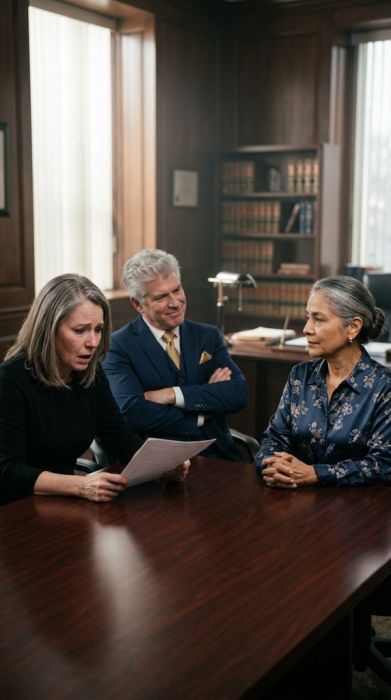
The discovery came three weeks before the wedding. I was at Larkspur House, reviewing the ballroom setup, when a friend of mine — a careful accountant who handled the estate's books — pulled me aside with a worried expression and a folder.
"Ruth," he said quietly, "you need to see these."
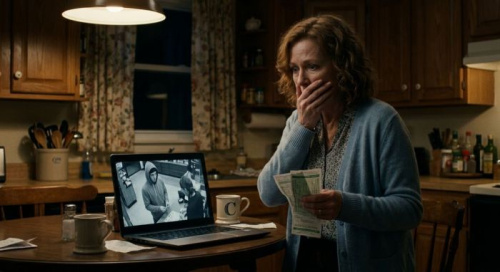
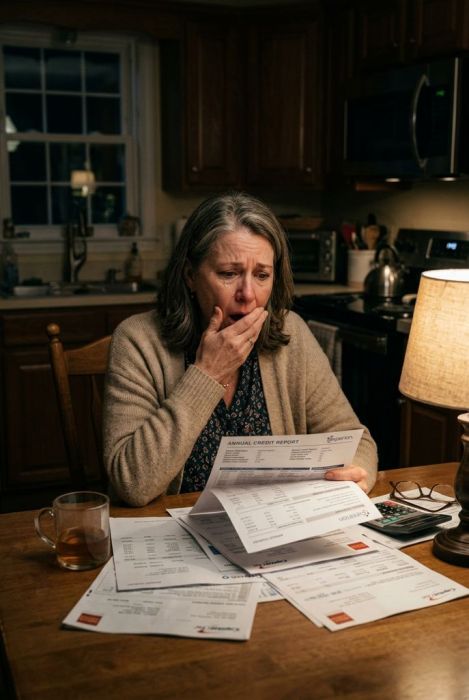
The folder held a stack of checks. Evelyn Hartley's checks. She had written them to the venue, to the caterer, to the florist, to the string quartet. And every single one had bounced. Not once — our bank had quietly rejected them, flagged the account, and returned them stamped with a cold, metallic word. Insufficient funds.
"What is this?" I asked, though I already understood.
"Her bank called ours," Sam said. "She's been writing checks against an account she's been running on empty for months. The Hartley fortune — it's a house of cards, Ruth. I'm sorry. The whole thing is about to collapse."
I sat there in the empty ballroom, the evening light falling across the polished floor, and I let the truth settle into me. Evelyn Hartley had been playing a part. The grand house in Greenwich, the charity galas, the private school tuition — all of it was borrowed, leveraged, and about to come apart at the seams. And this wedding, all this "gift to the children," had been her last desperate performance. A stage where she could pretend, in front of everyone who mattered, that she was still wealthy.
And I had been her unpaid supporting actress. The poor relation she could point to and say, with a gentle smile, "We really are so lucky." Because if you stand a shabby widow next to a grand lady, no one questions which one has money. Evelyn had used me as her camouflage.
I could have confronted her that day. I could have called every vendor and told them she was a fraud and canceled everything. But my daughter deserved her wedding, and Grant was a good man who loved her, and the Hartley grift was not his doing. So instead I sat down at the old wooden desk in the estate office, and I did what my mother had taught me to do with a basket of laundry: I folded everything carefully, in its place, and I waited.
I paid the caterer. I paid the florist. I paid the string quartet and the lighting company and the hotel where the out-of-town guests were staying. Every invoice that bore Evelyn's beautiful, worthless name, I quietly paid myself, out of my own accounts, leaving no trace but the receipts. My husband's life insurance, set aside for our daughter's happiness, went to make sure that no one else in her bridal party would be humiliated by Evelyn's empty checks.
On the morning of the wedding, Evelyn cornered me in the bridal suite. Her champagne gown was perfect. Her hair was perfect. She looked at my pale blue dress — the one she had tried to make me change — and she smiled her cat's smile.
"I do hope you've prepared something, Ruth," she said sweetly. "A little something to say, for the mother of the bride. Perhaps just a few sentences. Don't you worry if it's not very long. Everyone understands."
And she left, a little cloud of perfume trailing behind her, confident she had finally won.
The ceremony was beautiful. Mia looked so radiant I thought my heart would crack open and pour light all over that old estate. Grant cried during the vows, and I forgave Evelyn a dozen small cruelties just for raising a son tender enough to weep at his own wedding. For a few hours, I almost let it go. I almost let her have her victory, filed away all that humiliation in the same drawer where I kept the other quiet hurts.
But then came the reception, and the toasts, and Evelyn standing at the microphone with her champagne in one hand and her little leather notebook in the other.
"My darlings," she said, and her voice rang across the ballroom, "I want to thank you all for being here to celebrate my son and his beautiful bride. And I want you all to know —" she paused, letting the room lean in, "— that this entire evening, every beautiful detail, is our gift to the children. Every plate, every petal, every note of music." She gestured grandly around the historic room. "We spared no expense. Because this family —" and here her eyes found mine, soft and triumphant, "— this family gives from a place of privilege, and we are simply so blessed to share it."
The room applauded. Heads turned. Someone whispered how generous the Hartleys were.
And then it was my turn.
The mic reached me, and for a moment I just held it, watching the room, watching Evelyn settle back into her chair with the satisfied ease of a woman who believed she had won. I thought about every "bless your heart." Every corrected napkin. Every time she had made my daughter squeeze my hand under the table to keep me from crying.
"Mia," I said softly, and my daughter's eyes found mine, shining. "Grant. You two are the reason this room is filled with love tonight. And I want you to know that everything Evelyn just said to you, every beautiful word about giving from a place of privilege —"
I paused, and let the silence stretch.
"— was true."
Evelyn smiled.
"Except for one small detail," I went on. "This evening wasn't a gift from the Hartley family. It was a gift from me."
A ripple went through the room. Evelyn's smile froze.
"You see, this venue — Larkspur House — has belonged to my family for three generations. I own it. I've owned it since my father passed it down to me, and I've run it with my own hands for forty years. The hydrangeas on every table come from my greenhouse. The caterer Evelyn will tell you she hired at her expense — I paid her invoices, because hers bounced. The florist, the quartet, the lighting, the hotel rooms for your out-of-state guests — I paid them all. Every single check Evelyn wrote to make this wedding happen came back stamped for insufficient funds."
The room went utterly silent. Someone dropped a fork. Grant looked between his mother and me, his face going white.
"No," Evelyn breathed. "That's absurd. That's — how dare you —"
"I have the receipts," I said quietly. "Every one of them. I kept them, Evelyn, the way I kept every one of your little 'bless your hearts.' You used me for months. You pointed at the shabby widow and told the world she was your charity case, so no one would look too closely at where your money actually was. And the whole time, your fortune was a balloon with a pinhole in it. Your checks have been bouncing for months. Your Greenwich house is mortgaged to the rafters. It was all borrowed, Evelyn. All of it."
I turned to Grant, who was shaking. "Grant, I am so sorry you're learning this here. Your mother didn't know I owned this place — she never asked. She assumed, the way she assumed about everything. But I am not taking anything from you. You love my daughter, and that is worth more than all the bounces in Evelyn's checkbook."
Grant looked at his mother, and something in his eyes broke and then hardened. "Mom," he said, his voice gravelly. "Is that true?"
Evelyn stood up, her champagne glass trembling, her face a blotchy ruin of denial. "I am a Hartley," she said. "I don't have to explain myself to—"
"Every check," I repeated, soft and final, "bounced."
And that was when the second door of the ballroom opened, and a man in a dark suit stepped in with a folded document. I hadn't planned it — not exactly — but I had made the call that morning, just in case. The accountant at her bank had been watching her account drain for weeks, and when I'd told him what she'd done to my daughter's wedding, he had finally picked up the phone to the state's attorney's office. A woman who writes bouncing checks across three counties to fund a wedding she can't afford has a name for what she does, and that name was about to catch up with her.
"Evelyn Hartley," the man said, and his voice carried across the silent room. "I need you to come with me, please."
She looked at me, finally understanding, finally catching the look she had thrown me so many times — the cat, at last, cornered by the mouse. Her lips moved, but no sound came out. And then she set down her glass and walked, very slowly, out of the ballroom, her own champagne-colored lie trailing behind her.
No one clapped. No one dared. The silence held her like a warning all the way out the door.
I won't pretend that the rest of the evening was easy. Grant's father, humiliated and grey-faced, sat quietly for an hour and then shook my hand without a word, his eyes full of a grief I couldn't fix. Grant himself was devastated, but Mia held his hand the whole night, and I watched her do for him what she had done for me all those months — stayed close, kept him standing, refused to let him fall.
But here is the part I want you to remember, because it is the part that matters. My daughter danced her first dance. She laughed with her new husband. And late in the evening, when the string quartet had packed up and the candles had burned low, she found me on the terrace, still in my pale blue dress, and she wrapped her arms around me and wept.
"You did this," she whispered. "You gave me this. You gave it to both of us, and you never even told me you were carrying it."
"I would carry anything for you," I said, "a hundred times over. That's what a mother does. I just waited for the right moment to put it down."
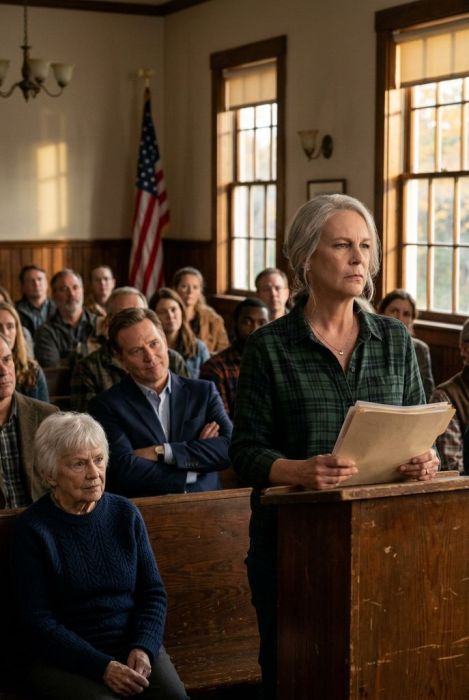
The Hartley fortune collapsed, exactly as I had known it would. The house went to the bank. Evelyn faced the consequences of her checks and her schemes, in a quiet courtroom where no one was fooled by her smile anymore. Grant and Mia built their life on something sturdier than borrowed money — they built it on truth, on the two of them, on a foundation I had quietly poured for them when no one else was watching.
And Larkspur House, my home, my legacy, hosted every grand moment of it: the anniversary parties, the first grandchild's christening, the summer evenings on the terrace where Mia laughed with her children. I sit out there now, sometimes, in the last of the light, and I think about Evelyn — where she ended up, and how she spent her final moments in that ballroom, understanding at last that the shabby widow in the pale blue dress had owned the whole thing from the very beginning.
Some people think wealth is a thing you are given. But I know better. Wealth is a thing you hold quietly, for the people you love, until it's time to set it down where it will protect them forever. I waited nine months for that moment.
It was worth every single second.