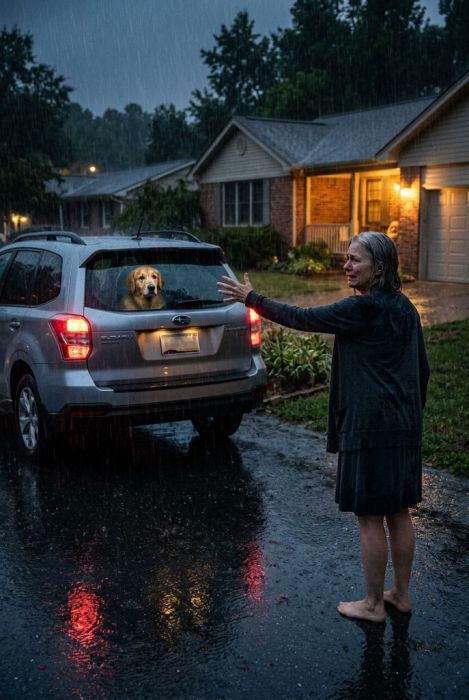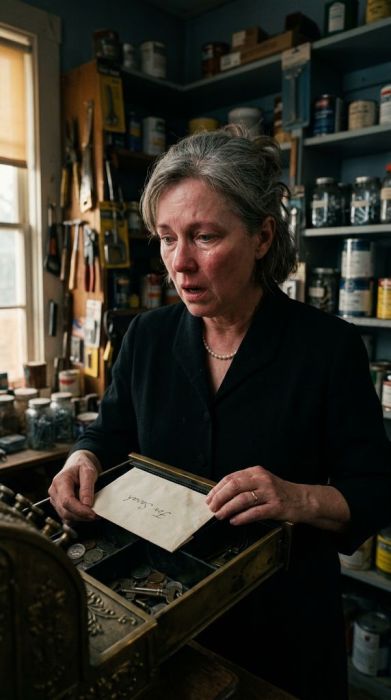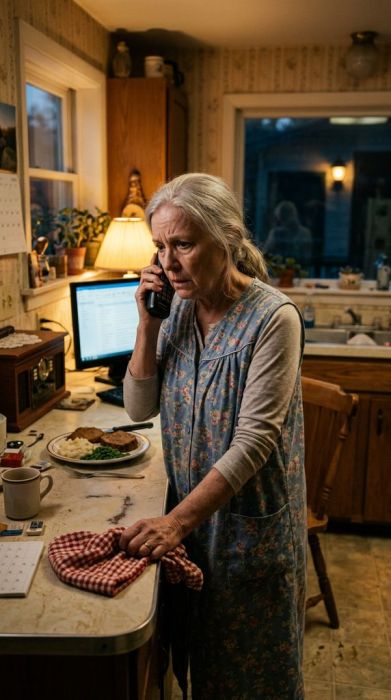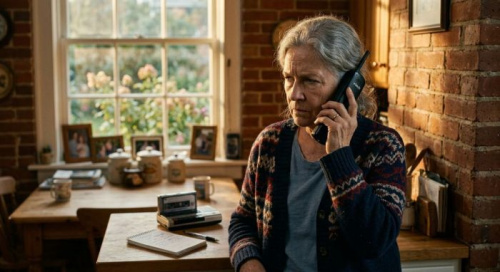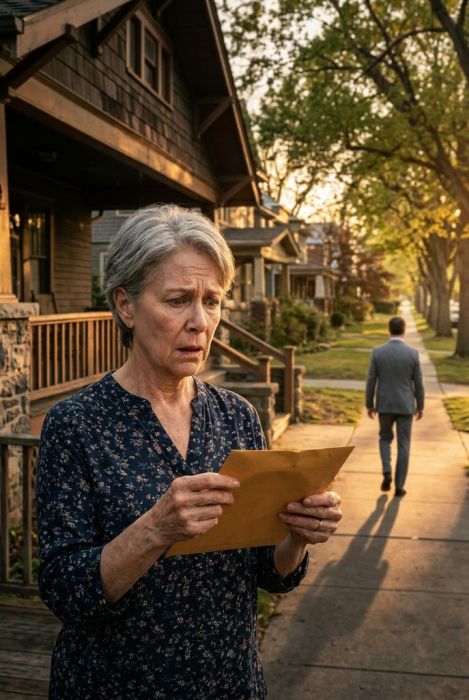
The certified letter arrived on a Tuesday, three weeks after Jake Mercer's crew tore half the shingles off my roof and vanished. I signed for it at the front door with damp hands, still scrubbing kitchen counters the way I do when I'm trying not to think about the patch of sky showing through my bedroom ceiling. The envelope came from a lawyer I'd never met. The subject line read: Notice of Claim of Lien. Jake claimed I owed him forty-five thousand dollars, and if I didn't pay, he would force the sale of the house Tom and I had built our whole life in.
Fourteen months earlier, Tom had a heart attack in his garden. He was gone before the paramedics reached him, kneeling in the tomato rows he babied every summer like they were his children. The life insurance paid off the mortgage and left just enough to fix the roof he'd been putting off for years. "Don't wait on the roof, Carol," he used to say, patting the kitchen ceiling like an old dog. "A house falls apart from the top down." I'd laughed at him. I stopped laughing the morning a leak dripped cold water straight into my cereal bowl, three months after his funeral.
The neighborhood I live in is the kind where people still wave from their driveways. My neighbors knew Tom. They brought casseroles and quiet nods when he died, and they watched me climb onto a folding chair with a bucket whenever it rained. I could feel their pity through the windows, and it burned worse than the leaks. I wanted to fix the roof myself, the way Tom would have. But I couldn't. I'm sixty-one years old, I'd never held a roofing nail in my life, and my knees had stopped forgiving me years ago.
Derek, our son, was the one who recommended Jake Mercer. They'd played baseball together in high school, and Derek swore by him. "Mom, Jake's company is huge now," he said. "Rooftops all over town. He'll take care of you." Jake came to the house with a clipboard, a warm grin, and a polo shirt with his company name stitched over the heart: Mercer's Best Roofing. He asked about Tom with genuine-sounding sympathy. He told me stories about Derek stealing second base in the championship game. By the time he left, he'd made me laugh twice, which was two more times than I'd laughed in months. He quoted eighteen thousand for a complete tear-off and replacement, fifteen hundred less than the other two bids. "Family discount, Mrs. Benson," he said. I wrote him a check for nine thousand that afternoon — half up front, the way every contractor in three counties asked.
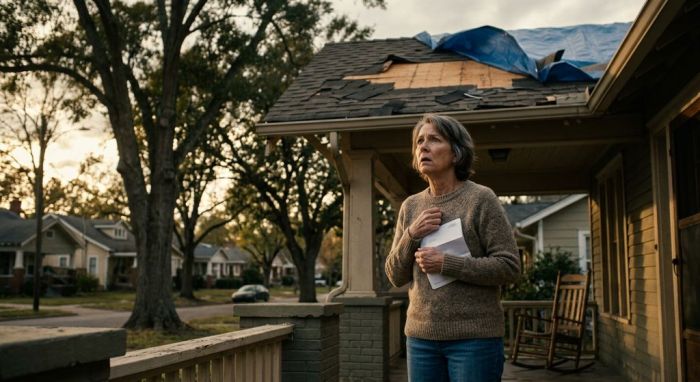
The crew arrived the following Monday. Polite kids in matching shirts, quick and efficient, and by Friday they had the old shingles stripped clean off one whole side of the roof. I made them lemonade and told myself the worst was over. Then Monday came, and nobody showed up. I called Jake. Rain, he said, bad weather moving in, couldn't risk the decking. Then it was a supplier problem. Then a key guy quit. Then two key guys quit. His texts went from apologetic to short to silent, and the bare plywood sat there drinking every storm that passed, because my house had become a sieve.
I drove to his office on Broadway the third week. The lights were off. A faded sign in the window said the office had relocated. I called the number on the sign, and when Jake finally answered, he told me his mother had been in the hospital and he'd be back the next week. The next week became two. The two became a month. The stain on my living room ceiling spread into something that looked like a map of a country I didn't want to visit. My neighbors stopped waving. They just watched.
When Jake finally reappeared, he came alone. No crew, no truck, no shingles. He sat at my kitchen table with a folder and that same warm grin, and he told me there had been complications. Asbestos under the old layers. Rotted decking. Extra labor. He slid a change order across the table — forty-five thousand dollars on top of the original — and asked me to initial at the bottom. I read it twice. "Jake, I don't have this money. And you never mentioned asbestos before." He shrugged like a man who'd been through this a hundred times. "Think about it, Mrs. Benson. I can't keep my crew on hold forever." Ten days later, the certified letter arrived. His lawyer, a man named Gerald Pike, wrote that the lien had been filed. Unless I settled the full amount, he would begin proceedings to force a sale. Foreclosure. On a house that was paid for. On the home where I'd buried my husband and raised my son.
I called Ruth Delgado before I called anyone else. Ruth is my best friend, and for thirty-one years she worked in the county clerk's office, where every lien, deed, and judgment in three counties crossed her desk. She read the letter twice, the way I had, and then she went very quiet. "Let me check something, Carol. Don't pay him anything. Don't even call him." Two days later she came back with a manila folder fat as a dictionary. Jake Mercer had filed liens on four other properties in the past three years. Two widows. A retired veteran. A couple in their eighties. In two of those cases, the houses had been sold at forced auction to satisfy his claims. The pattern was identical every time: deposit, partial work, a change order nobody remembered signing, a lien for the full amount. Every case had been handled by the same name: Gerald Pike. Then Ruth slid out one more sheet — a public record from the state licensing board. Gerald Pike was not a lawyer. He had never been a lawyer. He was Jake's uncle, a retired insurance salesman who'd lost his license years ago for doctoring signatures on policies.
I cried that night the way I hadn't cried since Tom's funeral. Not for the money. For the shame of it — the sick feeling of being chosen, of being sized up as exactly the kind of mark these men built their business on: a recent widow, a checkbook, a leaky roof, and no one to tell her no. Tom would have seen through Jake in five minutes. Tom kept everything, every receipt and contract, filed away in a fireproof box in the basement that he'd labeled in his neat engineer's handwriting: HOUSE PAPERS — DO NOT LOSE.
The next morning I went down to the basement. The box was still under the workbench, exactly where he'd left it, next to his old saws. I don't know what I expected to find — maybe nothing, maybe just the comfort of his handwriting. But Tom had kept more than I remembered. Warranties, receipts, the deed in a plastic sleeve, and a spiral notebook where he'd logged every contractor who'd ever worked on the house, with notes in the margins. "Arrived 8:04, polite, quote fair." "Changed price mid-job. Watch this one." And tucked behind the notebook, something I'd forgotten entirely: a small digital recorder he'd used for dictation. I pressed play out of pure reflex, and Tom's voice filled the basement, clear as the day he'd recorded it. He'd started taping conversations with contractors, he explained, after a painter tried to pad his bill. "If it's important enough to sign, Carol, it's important enough to keep."
That was the moment the fear let go of me. I didn't fight the lien with my heart in my throat. I built a case, the way Tom would have built one, one document at a time. Bank statements showing every check I'd written. Text messages where Jake promised to finish and never did. A letter from the county building inspector confirming that no permit had ever been pulled for my roof — because a man who pulls no permit isn't usually planning to finish the job. And the change order Jake claimed I'd signed: I had never signed it, and I could prove it, because my checkbook, my bank, and my neighbor across the street could all place me twenty miles away on the afternoon he said I'd initialed it. Ruth's son Mark was a paralegal, and he found the first crack in Jake's story: the signature block on that change order had been signed by a notary named Sharon Pike, whose commission, Ruth discovered, had been revoked in the next county two years earlier for stamping documents nobody had actually signed. I called the state bar association about Gerald Pike. I called the sheriff's fraud unit and handed them Ruth's folder. And I said nothing to anyone else. Three weeks later, Jake filed his motion to force the sale of my house. He was so confident he'd even sent me a text the night before the hearing. "See you in court, Mrs. Benson. Bring your checkbook."
The hearing was on a Thursday, in the same courthouse where Tom and I had gotten our marriage license thirty-seven years earlier. I wore my good blue dress and carried a cardboard box — not a briefcase, a box, because a life is not a briefcase. Jake sat across the aisle next to Gerald Pike, both of them smiling like men who'd never lost. Derek sat beside me. He'd shown up at my door the night before with red eyes and a voice that kept breaking. "Mom, I'm so sorry. I didn't know. I swear to you, I didn't know." I believed him. Jake had fooled plenty of people smarter than both of us. When the judge called my name, I stood, opened the box, and unpacked a year of my life onto the table. The original contract. The forged change order I'd never signed. Bank records. Text messages. The inspector's letter. The licensing board's page on Gerald Pike. The notary's revoked commission. And Ruth's folder — four other families, four other liens, two houses already lost.
The judge read for a long, quiet moment. Then she looked over her glasses at Gerald Pike and asked him, very politely, to produce his bar number. Pike's face drained to the color of old paper. He opened his mouth, closed it, opened it again — and then a deputy sheriff was walking up the aisle with a detective behind him, carrying papers that had nothing to do with civil court. Jake stood up so fast his chair went over. His uncle was being read his rights right there in the courtroom, and Jake Mercer, the man who'd stripped my roof and tried to take my house, was led out through the side door with his hands behind his back. The judge voided the lien from the bench. She ordered restitution for the damage to my roof and my legal costs. She looked at me and said, quietly, "You came prepared, Mrs. Benson." I just nodded, because I couldn't explain to her that half the preparation had been done by a man who was already gone.
The charges landed in the weeks that followed. Forgery. Filing false documents. Attempted fraud. And when the other victims read about it in the paper and came forward — the veteran, the couple in their eighties, the two families who'd lost their houses — the list grew longer. Jake Mercer took a deal that sent him to prison for four years and required restitution to every family he'd hurt. His uncle was charged separately, and the county struck every lien the two of them had ever filed from the record. I didn't gloat. I didn't even feel angry anymore. I felt something rarer. I felt believed.
It took six more months to finish the roof. I hired a company Ruth's church swore by — a father and three sons who showed up at seven every morning and didn't leave until the last nail was in. I paid them with the restitution check, and I stood in the yard the day they finished, watching the sun come off a roof that finally looked like a roof, and I felt safe in my own house for the first time in two years. The next Saturday, Mrs. Harmon from across the street brought me an apple pie and said she was glad I'd won. I told her I was glad too.
Derek comes over for Sunday dinner now, every week, and he checks the gutters before he leaves, and I let him. Last spring I planted tomatoes in Tom's old rows and they grew taller than both of us. And on the shelf by the back door, next to the coffee canister, there's a new fireproof box with my label on it in my own handwriting. HOUSE PAPERS — DO NOT LOSE. Tom was right about the roof. A house falls apart from the top down. But it can be put back together, too. One honest tradesman — and one dead husband's notebook — at a time.