The first thing my mother-in-law did at my husband's memorial was not to weep. It was to stand in front of the fireplace in the farmhouse my husband and I had rebuilt with our own hands, raise her chin, and address the thirty-odd people who had come to say goodbye to her son.
"Now that Ben is gone," Eleanor said, "we need to talk about the house."
I remember the way the whole room went quiet. My daughters, Marie and little Carrie, had just set down plates of the pot roast their father had loved. They froze mid-step. I felt my heart drop into my stomach, but I kept my face perfectly calm. I had been Ben's wife for thirty-four years, and I had learned, by then, how to keep my face calm.
Eleanor had never liked me. She had made that plain from the very first Sunday she drove up our gravel drive in her pale blue Cadillac, when Ben brought me home to the farm as his brand-new bride. She looked me over the way a woman inspects a piece of used furniture, and she did not offer me a seat.
"You're marrying my boy," she said that day, "and this farm will never belong to you. Remember that."
I remembered. I remembered it for thirty-four years, through the births of our daughters, through the years of drought and the years of plenty, through the mornings we woke before sunrise to feed the cattle and the nights we fell into bed too tired to speak. Ben and I built that farm. We modernized the barn, we drilled a new well, we painted every fence post, and we paid off every acre with our own sweat and our own checks. Eleanor never lifted a finger for any of it. But she always reminded me that her name was on the old deed, the one her husband had signed over to her when he died, when Ben was just a boy.
The way she told it, that made her the owner of everything forever.
For years I swallowed my pride. I invited her to every holiday, I cooked her favorite dishes, I let her rearrange my kitchen cupboards and criticize my gardening. I believed, the way a kind woman does, that if I just loved her son hard enough and was patient enough, she would eventually soften. That was my mistake. Eleanor did not soften. She just waited.
When Ben's heart gave out last April, quiet, in his sleep, the way he had always hoped it would, I thought the worst was over. I thought the hardest part was the papers and the casket and holding our daughters while they cried. I was wrong. The real fight did not even begin until the day we buried him.
At the memorial, Eleanor let the room settle, and then she looked straight at me.
"June," she said, "I'm going to say this plainly. This house was my son's father's. It is mine now, by law. I don't blame you for Ben's passing, well, I do, a little, the way you worked him to death, but I'm not a cruel woman. I'll give you one week to pack your things. After that, I'll be moving in with my sister, and you'll be gone."
I could not speak. I could hear Marie gasp, and I could feel little Carrie clutching the back of my blouse. Somewhere behind me, our old friend the sheriff cleared his throat, but he said nothing. Nobody said anything. And Eleanor stood there, tall and gray-haired and righteous, folding her arms like she had just won a case she had been preparing for thirty-four years.
The thing is, and this is what broke my heart, she almost had me convinced.
All week I walked through my own house like a ghost. I packed boxes. I cried in the laundry room where Ben's flannel shirts still hung. I told myself she was right, that the old deed was hers, that I was just a tenant in my own life. I pulled down the boxes of Christmas ornaments and the wedding photo albums and the little glass bird Ben had given me on our tenth anniversary, and I grieved for everything I was about to lose.
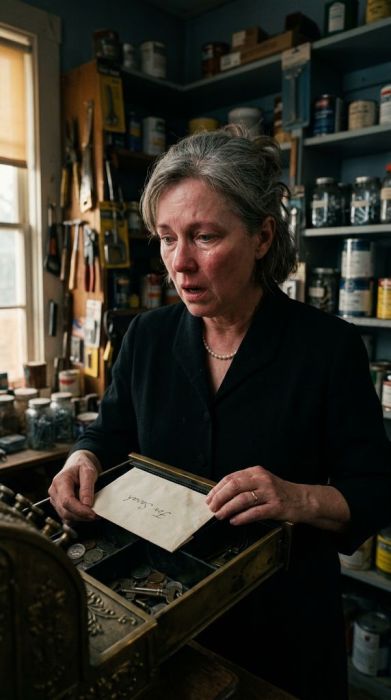
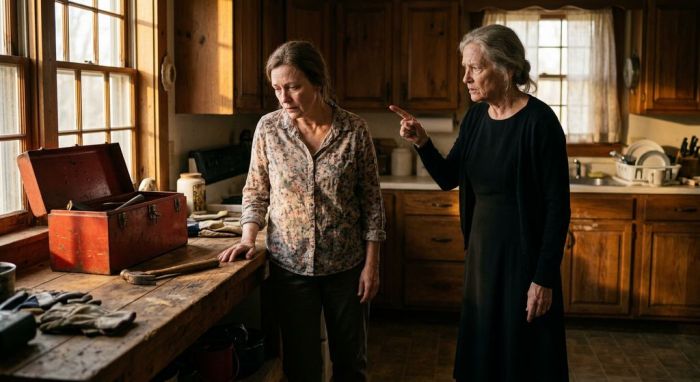
Then, on the fifth night, I did something I had put off for as long as I could. I decided to open the toolbox in the barn, the red one Ben had kept locked with a little brass padlock for as long as I had known him. I thought I might find his old pocket knife, or the lucky penny he always carried. I did not expect to find what I found.
The lock was not fully shut. It was hanging open, just a crack, as if he had meant to come back and close it. I knelt on the cold floor of the barn and lifted the dented lid, and the first thing I saw was his old work gloves, folded on top of a stack of yellowed paper.
Underneath the gloves were papers. I pulled them out slowly, my hands unsteady. They were not bills or receipts. They were legal documents, tied with twine, and on top of them was a note in Ben's crooked handwriting.
"June," the note said. "If you're reading this, I'm gone. I want you to know I fixed it. I fixed everything. Look at the deed."
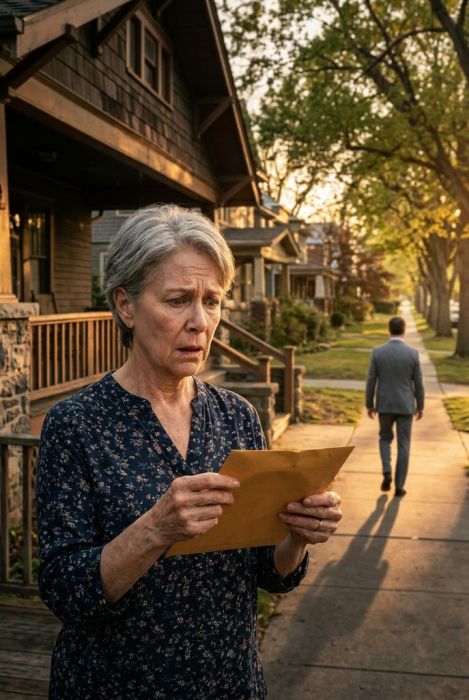
I unfolded the deed with shaking fingers. It was a newer document than the one Eleanor bragged about, dated eleven years earlier, the year we finished paying off the land. It was signed by both Ben and myself, and it transferred our portion of the farm into a shared title held jointly by the two of us, and in the event of either of our deaths, fully to the surviving spouse.
Ben had never told me. He had suspected, all those years, that his mother would try to take what was ours. And so, without a word, without making a fuss, he had quietly gone to our lawyer and made sure I could never be thrown out of my own home.
There was more. Under the deed was a second document and a letter addressed to the sheriff.
I read the letter with my heart pounding. It said, plainly and in Ben's own words, that on many occasions his mother, Eleanor, had attempted to pressure him into signing over the farm to her, and that he had refused every time. It said that if anyone ever claimed the farm belonged to her, they should know the truth: Eleanor had no claim to a single acre, because Ben had legally separated his portion from hers years before, with our lawyer as witness.
I sat down on the floor of the barn and cried until my ribs hurt. Not from grief this time. From relief. From the sheer, overwhelming shock of being loved that fiercely by a man who never once told me he had done it, because he knew I would have argued with him about the cost of the lawyer.
By morning I had made up my mind. I was done being kind. I was done being patient. I was done packing my own house.
That Saturday, Eleanor arrived with two of her nephews and a rented truck, ready to watch me leave. She stood in my kitchen with her hands on her hips, wearing a brand-new floral dress, and she did not even bother to hide the satisfaction on her face.
"Ready, June?" she said. "The truck's here. I told you a week, and I'm a woman of my word."
"Actually, Eleanor," I said, "let me show you something first."
And I set Ben's deed down on the kitchen table and smoothed it flat.
For a long moment she just stared at it. I watched the color drain out of her face, then flood back in angry red. She snatched the paper up, held it to the light, read it twice, and then she laughed, a harsh, brittle laugh.
"This is a forgery," she said. "You think you can fool me with some scrap of paper? My husband's deed is the real one. I'll have you in court."
"I don't think you will," I said.
And that was when the sheriff came in through the back door.
He had been a friend of Ben's for forty years, and Ben's letter had reached him that morning. He stood there in his uniform, hat in hand, and he looked at Eleanor with more pity than anger.
"Ma'am," he said gently, "I have a notarized statement from a county judge, and a letter from your son. This farm was legally deeded to June the day they paid it off. That old deed of yours only ever covered the house lot, and Ben made a new one eleven years ago. There's a record in the county clerk's office."
Eleanor's nephews looked at each other. One of them quietly set down the box he had been carrying.
"This has to be a mistake," Eleanor whispered. "Ben would never do this to his own mother."
"He would never let you take his wife's home," I said. And it was the truest sentence I had spoken in years.
In the weeks that followed, the fight never went to court, because Eleanor knew she would lose. She threw one last scene on my porch, shouting things that carried across the whole field, and then the nephews loaded the truck with her furniture and drove her away. She never set foot on my farm again.
A part of me felt bad for her. Truly. She had spent decades clinging to a bitterness she had chosen, and at the end of it she had nothing but a faded old deed that was worth nothing anymore. She lost not just the farm but her soft memory and her granddaughters' respect. It has been a long time since anyone spoke to her, and I do not think they ever will.
But I will not pretend I am sorry. When I walked through my kitchen that first morning after she left, with the sun coming in low and golden across the same table where Eleanor had demanded the house, I felt something I had not felt in months. I felt light. I felt free.
I keep Ben's toolbox in the sitting room where we used to drink our coffee, and I left the deed inside it, just where he left it. I tell our girls the story when they ask. I tell them that love is not about grand gestures. It is about the quiet, stubborn, unglamorous work of making sure the people you love are never left helpless.
The farm is still mine. The cattle are still mine. The little glass bird still sits in the window where Ben set it many years ago. And when I stand on my porch in the evening, watching the sun sink behind the barn, I know I am not just safe and sound. I am exactly where I earned the right to be, and my husband's own hands helped me stay.