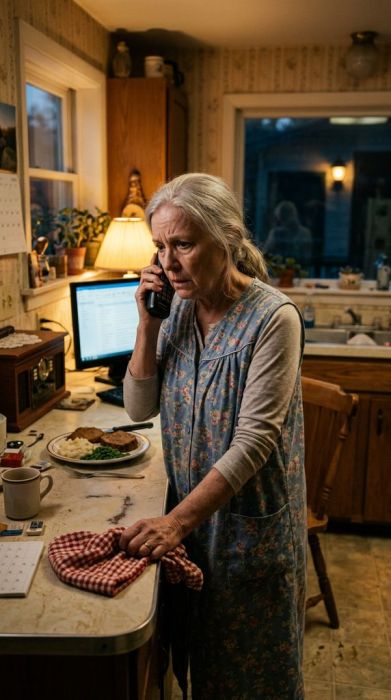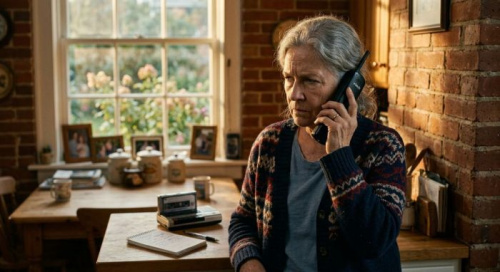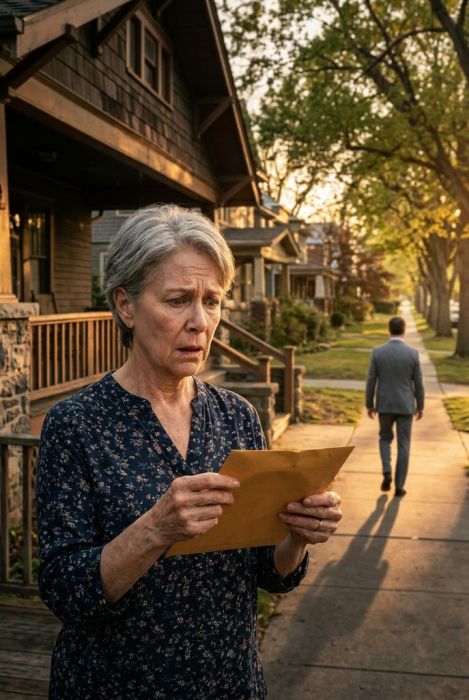
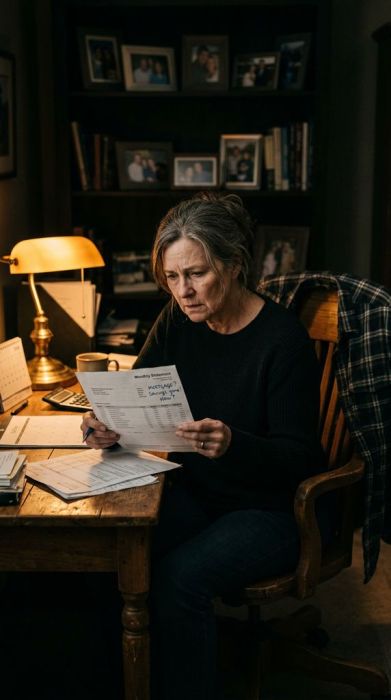
The call came on a Tuesday at 9:14 in the morning, which is how I remember it being real. My husband Frank had been buried exactly five days, and I was still moving through the house like a woman underwater — opening mail I didn't understand, answering phone calls I didn't remember taking. Gary Devereaux's voice on the line was warm and heavy, the way men's voices get at funerals. "Elaine, sweetheart, I need you to come by the office for an hour. Just some signatures. Frank and I had paperwork in progress, and it can't wait for the bank."
I should have asked what paperwork. I didn't. Frank had trusted Gary for thirty-one years, the way you trust a man who held your baby at her christening and drove four hours to your father's funeral. My husband's best friend. My children called him Uncle Gary.
So I drove to Blue Ridge Mechanical, the HVAC company Frank had started with Gary when they were twenty-six and ten dollars short of broke. I sat in the conference room where Frank's jacket still hung on the back of his chair, and Gary slid a stack of papers across the table with a pen that had obviously been waiting for me.
"Just the partnership formalities," he said. "The bank needs clean signatures now that Frank's gone."
I signed the first page without reading it. On the second page, my eyes caught a date in the corner — printed in the little gray box that computers make. The date was the day after Frank died. And on the line below mine, there was already a signature. Not mine. A neat, practiced imitation of my name that someone had written with the same pen that had been waiting for me.
I kept my face still. I'd spent forty years as an office manager at Asheville High, and I knew one thing absolutely: you never tip your hand in the middle of a meeting. I turned the page, smiled at Gary like the grieving widow he expected, and said, "Of course. Is that everything?"
He said it was everything. He walked me to my car and kissed my cheek, and I drove home with Frank's jacket in my lap, feeling the anger come up slowly, the way water rises in a basement you didn't know had a leak.
That night I started with the obvious places. Frank's workshop. His nightstand. The box of tax returns in the closet. Nothing seemed unusual — which was itself unusual, because Frank saved everything. Receipts, warranties, the ticket stubs from every movie we ever saw, with the dates written in his small, careful hand.
Then I found the statements.
They were in the bottom drawer of his desk, underneath the holiday card box, rubber-banded together — six months' worth of Blue Ridge Mechanical bank statements. Frank had never brought bank statements home. Gary handled the money side of the business; that was their arrangement from the beginning, and Frank trusted it the way he trusted everything about Gary.
But on the sixteenth page of the January statement, in the margin, in Frank's handwriting, were three words: "Check this, Elaine."
I looked. It was a payment of nine thousand dollars to something called Devereaux Consulting Group. I knew Linda Devereaux had a consulting business — she sold "efficiency packages" to small companies and talked about it at dinner parties. What I didn't know was why Blue Ridge Mechanical was paying her nine thousand dollars a month for services she'd once described, with a laugh, as "mostly a fancy name for my shopping budget."
I found five more margins after that. "Again." "Same." "Ask about." At the bottom of the March statement, Frank had written something longer, in the careful letters he used when he was angry: "Gary thinks I don't see. I see."
My husband saw. And my husband prepared.
The problem was, I didn't know what he'd prepared. So I did the only thing I knew how to do: I made a list. I called every number in Frank's phone book. I talked to the men at the shop, the payroll woman, the bank manager Gary had introduced us to twenty years ago. Everyone was sorry for my loss. Everyone knew nothing, or said they knew nothing. Everyone was careful — the way people are careful when a big man in town has given them a reason to be.
Then, on the way to my daughter Becca's house that Sunday, I pulled into the parking lot of the law office on Patton Avenue, because I'd found one small thing more: a date in Frank's calendar, circled twice, with only the initials "R.C." beside it. Ruth Calder. The attorney who had drawn up Frank and Gary's partnership agreement the year our children were born.
Ruth had aged quietly and well, like Frank's business had. She looked at me across her desk for a long moment, then opened a file drawer and took out a manila folder with my husband's name on the tab.
"He came to see me six months ago," she said. "He didn't want to scare you. He thought he'd solve it himself and tell you when it was done."
"What did he want to solve?"
Ruth slid a single sheet across the desk. It was a receipt for a retainer — paid in cash — to a firm in Charlotte called Okafor & Associates. Forensic accounting specialists. Below the firm's name, in Ruth's handwriting: "Initial findings complete. Report delivered to client, April 12."
April 12. Three days before Frank's heart attack.
"He picked it up that afternoon," Ruth said softly. "He told me he was going to show you that night, after dinner. He said — and here her voice cracked, which made me love her forever — that whatever happened with the business, he wanted you to know every single dollar was accounted for. He said you deserved that."
I sat very still. The report was not in the file. Frank had taken it home, to show me, and he'd died before dinner.
I drove home and tore the house apart — gently at first, then with a kind of desperate care, the way you search a room for the last letter of someone you love. I looked in the places Frank kept things: the freezer, between the frozen peas, where he hid the Christmas money. The toolbox in the garage. The lining of his old suitcase. Nothing.
Then I remembered the one thing of Frank's I'd refused to touch: the pocket of his favorite flannel shirt, still hanging in the closet, still smelling like him.
In the pocket was a folded envelope. In it was the report from Dan Okafor — forty-three pages documenting that, over six years, Gary Devereaux had moved four hundred twelve thousand dollars out of Blue Ridge Mechanical and into companies controlled by his wife. It listed dates, transfers, invoices with no corresponding services. It even included a note Gary had sent Linda on an office computer, laughing that Frank "wouldn't know a balance sheet from a grocery list."
Clipped to the back of the report was a second letter, in Ruth's handwriting, addressed to me: "Elaine — Frank came back to me on April 14 with one more piece. He re-signed the buy-sell agreement I prepared for him after he first suspected Gary. Upon Frank's death, all voting control transfers to you and the children. Gary is not aware. A copy is held in my vault. Call me when you're ready. R."
I sat on the edge of the bed with Frank's flannel in my hands and cried for a while. Then I called Ruth, then I called my children, and then I started to plan — quietly, the way Frank would have planned.
We let Gary think he'd won. That was the hardest part and the most important. For six weeks I played the grieving widow who trusts her husband's best friend: I thanked him for managing things, apologized for being "silly" when I asked about a payment, and let him see me cry when a delivery truck came in with Frank's name still on the side.
Gary grew bold, the way thieves do when nobody watches. He stopped taking my calls on Friday afternoons. He moved the company payroll to a new bank. And in the fourth week, he told me, with a smile that was almost kind, that he'd found a buyer for the building — a national chain that wanted to expand. He said he'd handle it all and make sure I got "something fair." He didn't tell me the number, the buyer's name, or that the buyer's attorneys had already requested six years of financial records — because the buyer's investigators had already noticed the nine thousand dollars a month flowing to a shell company whose address was a mailbox in a UPS store.
The closing was set for a Thursday. Gary chose Thursday because he said it was "a good day for new beginnings." I agreed. I was at peace, in the way you are at peace when you have stopped being afraid of what a man can take from you, because you've already decided he will take nothing else.
The conference room at the buyer's legal office was full of suits. Gary wore his best funeral suit — the one he'd worn to Frank's, which I noticed, and which I let myself find satisfying. Linda sat beside him, wearing an expression of careful pleasantness, her consulting smile oiled and ready. At the head of the table sat two attorneys from the chain, a woman and a man, with the kind of sharp, polite faces that mean they've already decided who the fool in the room is.
"I think we can wrap this up quickly," the woman said, opening a leather binder. "Mr. Devereaux, prior to signing, our firm has a standard disclosure requirement. We need you to confirm that the financial statements we've reviewed — the four hundred twelve thousand dollars in payments to Devereaux Consulting Group — represent legitimate business expenses."
The room went quiet. Linda's smile froze at the exact angle of a woman who has been struck by a thought she'd rather not have.
"Of course they're legitimate," Gary said. "Consulting. Linda's a consultant."
"Then I'm sure you can produce invoices," the man said pleasantly. "Service agreements. Deliverables. Anything, really — we've left three requests with your bookkeeper."
Gary's hand went to his tie. I knew that gesture. I'd seen it at our wedding, when he'd misplaced the rings. "Frank handled the paperwork," he said. "Frank passed. I'm sure the files are—"
"The files are here," I said.
No one had seen me rise. That's what Ruth told me afterward, anyway — that I stood up slowly from the seat at the end of the table, the seat they'd given "the widow," and set a manila folder on the polished wood with the quiet thump of a gavel. The same folder Frank had brought home on the last day of his life.
"I'm sorry," Gary said, and I could hear him trying on different voices, looking for the one I used to believe. "Elaine, this is a business matter, sweetheart. Let me—"
"The buy-sell agreement Frank signed on April 14," I said, "transfers voting control to me and our children upon his death. Ruth Calder has the original in her vault. I have a notarized copy here. And I have Frank's report."
I opened the folder. Inside was the first page of Dan Okafor's forty-three-page audit — the summary page, the one that began: "This report documents the diversion of approximately four hundred twelve thousand dollars from Blue Ridge Mechanical, Inc., between January 2020 and March 2026, through payments to Devereaux Consulting Group, an entity controlled by Linda Devereaux, for which no services were rendered."
Gary's face did something complicated. Linda's did something simpler: she made a small, flat sound, and her hand closed over the arm of her chair like she was steadying herself against a wave.
The buyer's attorneys exchanged one glance. That was all they needed. The woman closed her binder with a click and said, "This deal is dead, Mr. Devereaux. Our firm will be notifying the state banking authorities this afternoon, as we are required to do when a seller's representations are materially false."
Gary opened his mouth. Gary always had a mouth, and it had talked us through thirty-one years of dinners and deals and small kindnesses that made me feel like a fool for what I knew was coming next. But this time, for the first time I could remember, he had nothing to say.
The police arrived in the parking lot before Linda had finished gathering her purse. Two officers, quiet and professional, asking Gary to step outside. He went without a struggle, which almost disappointed me, until I saw the way he looked at me — with the flat, amazed hatred of a man who cannot believe the woman he'd been fooling had been fooling him instead. I held his gaze until they put him in the car.
Three months later, the bank's investigators found that Gary had opened a personal line of credit in Frank's name two days after the funeral — the forged signature I'd seen on the second page, the one he'd been practicing. That was the charge that stuck, along with the wire fraud and the embezzlement. He was convicted in the spring. He got seven years. Linda was charged as an accomplice; she took a plea and was ordered to pay restitution of two hundred thousand dollars, which she paid by selling her consulting business — or rather, by selling the house she'd bought with money it never earned.
Blue Ridge Mechanical didn't close. That's the part people don't expect. My son Marcus, a firefighter who can fix anything with a wrench and a patient expression, took over the field operations. My daughter Becca, a school librarian who reads contracts the way other people read novels, took the books. I stayed on as the accountable presence — the one who signs the checks and reads every page, in the small, careful way Frank taught me by example.
We sold the building to the same national chain a year later, for more than Gary's deal would have brought, because the company was healthy and honest, and honest companies are worth more. I took the money and did something I'd never done in my life: I bought a little house on the water, thirty minutes outside town, with a porch where I sit in the evenings and watch the light go down over the lake.
Frank's jacket hangs in my closet. His flannel shirt is still in the drawer. I keep them because I like them, not because I need them. I have a photo of Frank on the mantel from our fortieth anniversary, and I talk to him sometimes when I water the plants, the way you talk to people who know you completely and have no reason to judge.
He'd have loved the ending, I think. Not the revenge part — Frank was never vengeful. He'd have loved that his family was safe, that the business he built with his hands outlived the man who tried to take it, that every dollar, in the end, was accounted for — exactly as he'd promised me it would be.
My grandson asked me once why I keep the folder — the one from the closing, with the summary page inside. I told him the truth: "Because it's a love letter, sweetheart. Sometimes the people who love us most can't say it out loud, so they leave it in a file where we'll find it when we're ready."
He didn't understand. He's eleven. But he will. And when he does, I hope he remembers the way his grandfather wrote, in the margin of a page Gary thought no one would ever read: "Check this, Elaine. I see."