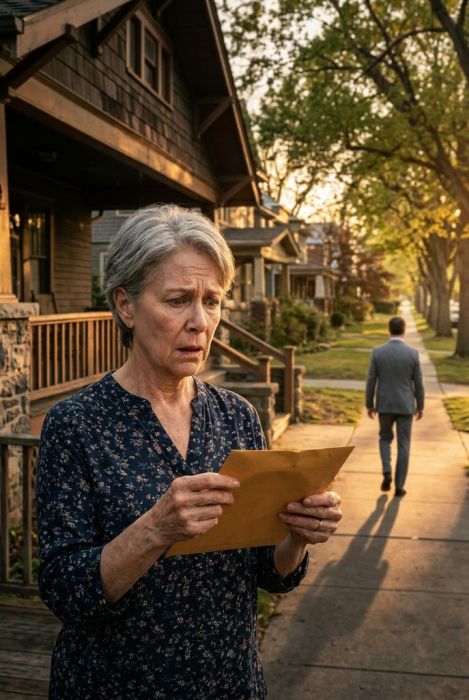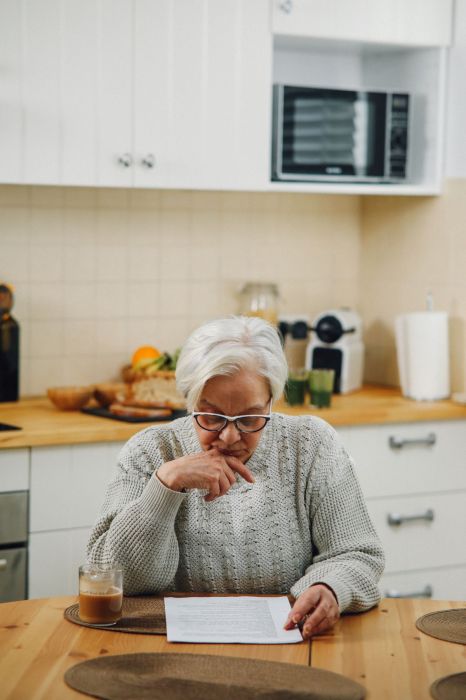
The March statement arrived on a Tuesday, and for twenty-five years I had almost thrown those backup copies away. Paul had moved us to paperless billing long ago, but the bank still mailed a duplicate to my sister Karen's house — a glitch neither of us ever thought to fix. It turned out to be the one small mercy of a marriage that had grown quiet. I opened the envelope over coffee, expecting grocery receipts and gas fill-ups. Instead, I found charges to a florist in Lake Geneva, a restaurant on the water, and a furniture store I'd never heard of. All dated on a Tuesday when my husband had sworn he was in Chicago.
I read the statement three times. Paul Sullivan and I had been married thirty-four years, and I had never once doubted his word. He was a steady man, the kind who kept his promises the way he kept his tools — organized, accounted for, rarely borrowed. We had raised two children, paid off two mortgages, and built a life that looked, from the outside, exactly like the one in the wedding photograph above the fireplace.
So I told myself there was an explanation. A client dinner. A wrong charge. I almost put the paper away. But I didn't, because I spent thirty-two years as a school librarian, and librarians notice the things other people skim past. I folded the statement and put it in the pocket of my cardigan, and I did not mention it to Paul that night.
The next evening I asked him about it. He looked up from his phone with that patient little smile he used when the kids were small and had done something they shouldn't. "Lake Geneva? Honey, I was in Chicago. You know I don't even like that town." He patted my hand the way you pat a dog. "You're probably tired. You've been forgetful since your mother passed."
My mother had been gone two years. My eyes were fine. My memory was fine. But I let it go, because that's what I had always done. I let things go the way you let a coat hang in the closet, sure you'll wear it again someday — and then one day you realize you never will.
The next Sunday, my best friend came to dinner. Nancy Prescott, widowed four years, my anchor since we were both young mothers on the same street. She brought wine and a new haircut and a car I'd never seen, and she talked a little too brightly about a weekend getaway she'd taken alone. I was happy for her. I truly was. It was the first time she'd smiled like that since Ray died, and I told myself that was enough.
Maybe that is why, when the April statement arrived with more Lake Geneva charges, I didn't tell Paul. I drove to the bank and asked for eighteen months of our joint account history, and the teller, a girl young enough to be my daughter, printed it out without a word. I sat in the parking lot and added the numbers on my phone. Two hundred eighty-four thousand dollars had left our savings in thirteen months.
The third discovery came by accident. Karen is a real estate attorney, and when she came over to help me sort through Mother's estate, I asked her to run a simple title search, just to be sure, I said, that Dad's name was finally off the old cabin. She called me two days later with a strange question in her voice. "Maggie, why does your house have a second mortgage with your signature on it? You never told me you took out a hundred and twenty thousand dollars."
I had never signed a home equity agreement. I had never even seen the document. Someone had borrowed against the home I had cared for alone while Paul traveled for work, using an electronic signature the bank had accepted without checking. When I asked the loan officer how that was possible, she said the signature had been "verified by notation." I learned later that phrase means nobody verified anything at all.
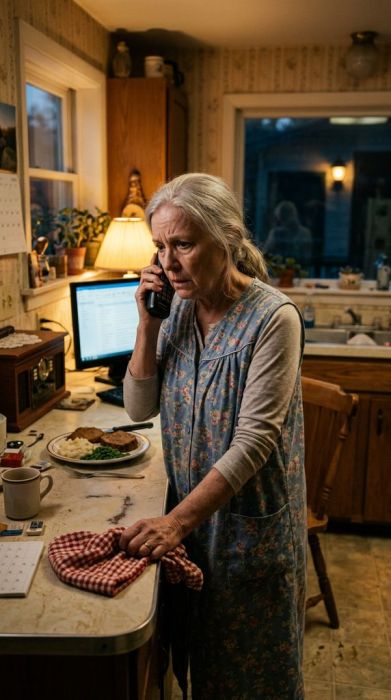
And that is when I began to suspect my husband. Not because I wanted to. Because the alternative was that I was losing my mind, and I decided, sitting in my kitchen that night, that I was not going to let him win by making me believe that.
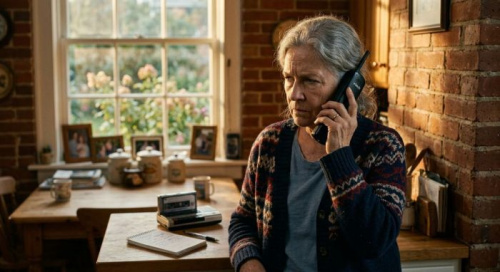
So I became the quiet version of myself. The version who nodded when he said I was confused. Who agreed to see a doctor about my memory and let Paul believe the appointment had gone badly. Who sat in that doctor's office and answered every question correctly while the doctor told me, kindly, that my mind was sharp as a tack — and then went home and told Paul, "They want to run more tests."
All the while, Karen was running the search I had actually asked for, the one on Lake Geneva. It came back on a Thursday night, and I remember the exact sound of her voice breaking as she read it to me. Fourteen Harbor Point Road, Unit 3, purchased in December, cash down payment, two names on the deed. One of them was Paul's. The other was Nancy Prescott's.
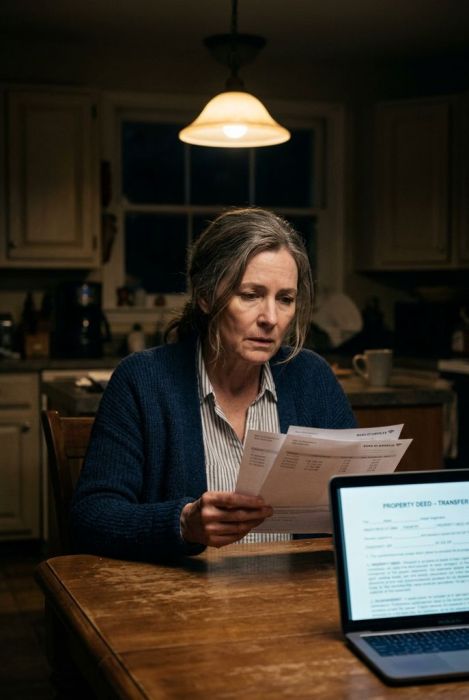
I didn't cry. I sat very still under the kitchen light and let the information settle into my bones. The woman I had held while she buried her husband. The woman who ate at my table every Sunday. The friend who had cried on my shoulder about how lonely life was, and how she wished she could find someone decent like Paul. It had all been one long, patient con — the money, the condo, the lies, and the careful cruelty of telling me I was confused while he drained my life away.
What I did next surprised even me. I didn't scream. I didn't confront them. Because a librarian knows that a story only ends well if you gather every page before you turn to the last chapter. Paul thought he was writing the ending. He had no idea I had been keeping my own copy all along.
For twenty-five years, through four moves and two babies and a thousand ordinary Tuesdays, I had kept the paper statements. Not on purpose, not out of suspicion, just because I am someone who keeps things. Shoeboxes in the attic. Files in the cabinet. When we sold the old house in 2009, I carried those boxes out to the car myself. Paul never once asked what was in them. Now I understood why that mattered. I had the receipts — proof of every transfer, every withdrawal, every check he had written to a company I'd never heard of. The money that bought the condo came from the life we had built together, and I could show a judge exactly how.
Karen brought me to a lawyer named Marta Delgado, who specialized in the kind of financial cruelty that leaves no bruises. Within a week, Marta froze what was left of the joint accounts. She filed the fraud report on the forged home equity signature, and the bank was only too happy to cooperate once they realized the alternative was explaining their policy to a judge. And I, playing confused better than I had ever played anything, let Paul believe his plan was running perfectly.
He grew bold. He started talking about selling the house to simplify. He suggested I might be happier in one of those nice senior apartments, as if I were eighty-five instead of fifty-eight. He spoke to me gently, patiently, the way you speak to someone you've already beaten. My daughter Erin called, worried about how quiet I'd been, and I told her I was fine. I meant it in a way she couldn't understand yet.
The end came at our anniversary dinner. Thirty-four years, Paul said, deserved the Edgewater, the old hotel on the lake where we'd had our reception. He made a toast to new beginnings. Then he set down his glass and told me, still smiling, that he'd found a buyer for the house, and that we'd be moving to something smaller, and that really, it was for the best, given everything.
I set my napkin beside my plate. "Actually, Paul," I said, "I have something for you first." I slid the folder across the tablecloth. Inside were the statements. The title search. The loan application with my name signed in a hand that was not mine. And a photograph, printed from the county recorder's office, of the deed at Fourteen Harbor Point Road, Unit 3.
He went pale, then red. "This is insane," he said, rising. "You're having an episode—"
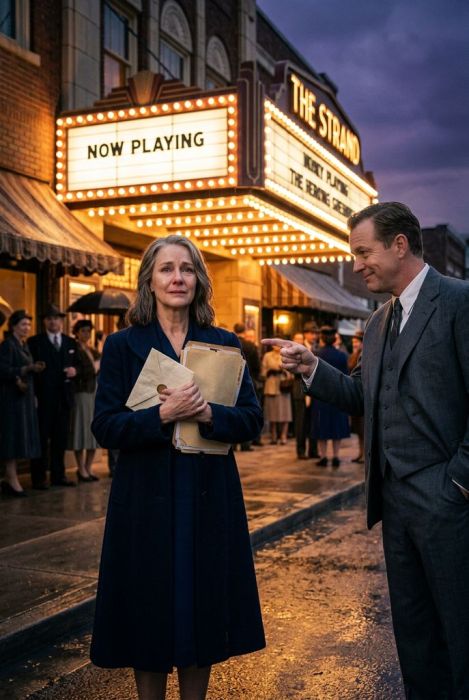
"Nancy's waiting in the bar," I said. "I invited her. I thought she should hear this with you." I nodded toward the doorway, and there she was, my best friend in the silk dress she'd worn to my mother's funeral, looking as if she'd swallowed a stone. The last twenty minutes of my marriage were the quietest they had ever been. Then Paul's phone buzzed, and when he answered it, his face changed. The bank's fraud investigator. The police were at the house on Manning Avenue, asking questions about a signature that didn't match.
He left in a hurry. Nancy tried to speak to me, but I shook my head. "You ate at my table for four years," I said. "I hope the condo was worth it." The maître d' asked if everything was all right, and I told him the dinner had been perfect. In a way, it was.
In the months that followed, the world did what it does when you hand it the truth. The bank pressed charges, and the district attorney took a keen interest in a man who had forged his wife's signature to borrow against his own family home. Paul lost his job the week the news reached his company. Nancy's name appeared in the same reports, and her children stopped returning her calls. The condo went into foreclosure when the payments stopped. I didn't have to lift a finger. I only had to stay out of the way while the two of them tore each other down.
Paul signed the house over to me as part of the settlement, the simplest way, his lawyer said, to make the criminal matter go away. He accepted a lesser charge, one suitcase, and a studio apartment in Milwaukee. Nancy sold the furniture from that very first florist's charge and moved to Arizona, where nobody knew her. Somewhere in the middle of it all, they became people I used to know.
It is a year later now, and I still live on Manning Avenue. The mortgage is paid off. The guest room is a library at last, all those shoeboxes properly shelved. Erin and Connor come for Sunday dinner, and we laugh more than we did when Paul lived here, because we stopped performing happiness and started actually having it.
Last weekend, Karen and I drove to Lake Geneva for lunch, just to close the circle. We sat at a table on the water and watched the sailboats, and I felt nothing but peace. The condo is a bank's problem now. The people who tried to erase me are living smaller lives than the one they tried to steal.
I still keep every statement, of course. Old habits. But the other day I realized I hadn't opened the file drawer in months. I don't need to prove anything anymore. The garden has tomatoes this year, the first I've ever grown, and they taste like the beginning of something. That's all I ever wanted, in the end. To sit in my own house, in my own quiet, and know that I was the one telling the truth all along.