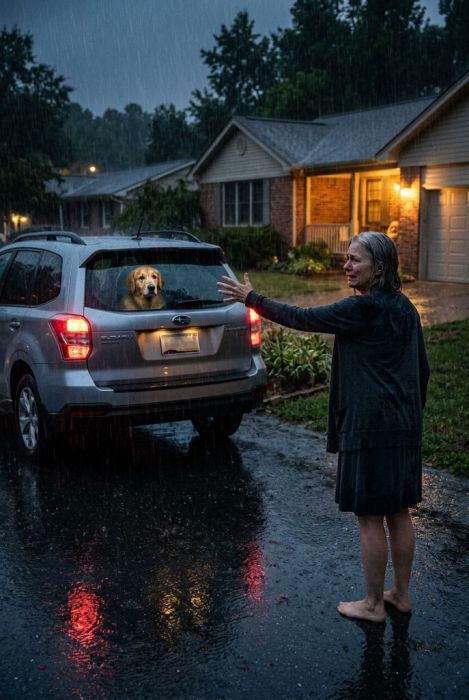
The day Russell cut the ribbon across the street, he stood on the curb and smiled at me like he had just won the lottery. He was holding my Mother's recipe, my Mother's name, and a key he had lifted off my ring when my back was turned. What he didn't know, as he waved to the whole town, was that Mama had left a single folded page hidden beneath my old dresser the night before she died. And that page was going to take his shop, his name, and that smile right back.
My mother, Beatrice, had built the little bakery on Whistling Hill with her own two hands and three stubborn mixers. Everyone called it Mama Bea's, and for fifty years the smell of her apple and pecan pies pulled people in from three towns over. She never advertised. She never had to. People drove past two better-known chains just to stand in line for the pies they swore nobody could copy.
I grew up with flour ground into my Saturday clothes, learning at her elbow from the time I could reach the bowl. Ruth was my sister, two years younger, and she was the opposite. She would rather chase ribbons at the county fair than wash a single pan. When Ruth married Russell Hartley and moved to the city, everyone figured the bakery would end with Mama. But it didn't. It ended with me.
I was the one who stayed when she got older. I was the one who froze her berries, boxed her crust, and wrote down her methods when her hands got too shaky to roll the dough. I am the daughter who dried the tears of customers we lost to time. I did not think—not for one day—that everything we built would ever become a war between in-laws.
It started the day we buried her. Russell called me while I was still in my black dress and asked to "look at the books." He said Ruth had always wanted half of the bakery. He said fair was fair and blood was blood. I told him there were no books to cheat, that the place barely turned a profit, that he was an asset and Mama's recipes lived only in my head and in my hands. He did not believe me. He smiled that same smile he'd use later on the curb, and my stomach turned.
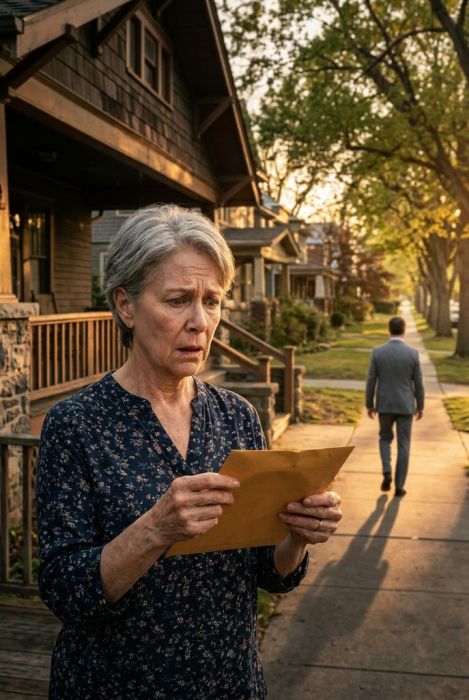
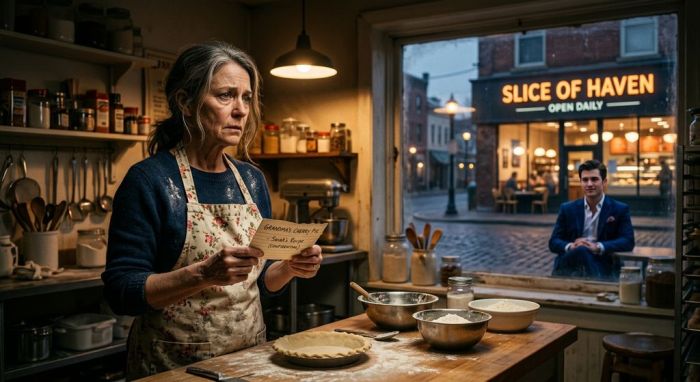
Three months later, a new white sign went up two doors down Whistling Hill. "Hale & Hearty Pies," broad print over a cartoon pecan. And Russell was in the window, holding a pie exactly like Mama's, with her name stitched into the fabric of his apron. I stood on that sidewalk until my knees ached. Every single person in town knew where that recipe had come from—because the only paper copy was the one I kept in my kitchen drawer, and Russell had visited twice after the memorial, "to fix a squeaky hinge," "to find a lost cufflink."
I did not confront him that day. I'm not the shouting kind. I have never once been the shouting kind. My whole life I let Ruth's loud voice fill the rooms she entered, and I grew comfortable being the one who stayed quiet while others posed it. But Mama said my quiet was like a river with a strong bottom. When I held back, she said, it usually meant I was planning.
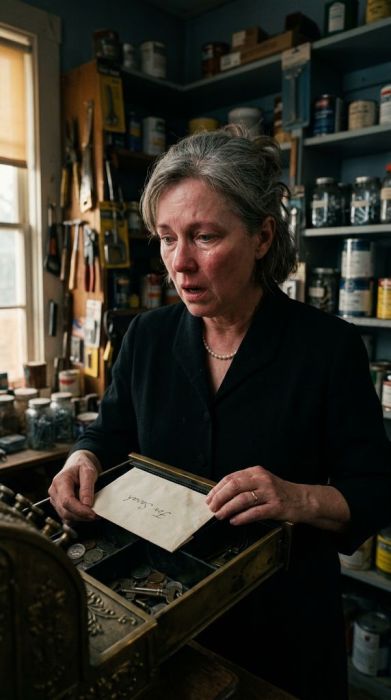
So I went home that evening and pulled out the drawer inside my old dresser. Tucked under the yellowed tray was the page she had hidden the night before she died—the one I'd sworn I wouldn't read unless I truly had to. Mama's handwriting. Neat, stinging, newer than the recipes I'd memorized. And at the bottom, a sentence I read four times before it sank. "If anyone ever takes my name or my pies, girl, remember this page is yours. Signed, witnessed, and notarized the spring before your marriage. I have always trusted you."
I sat on the braided rug of my own kitchen and cried. That calm and clever woman had known. She had seen someone coming along Whistling Hill that I had refused to see until it was standing in my own window. She'd spent years preparing a trap I had no idea existed until that exact moment.
I could have gone to the lawyers that week. But I wanted the town to believe it out. I wanted his own pride to hang him in front of every neighbor who had ever eaten my mother's pie. So I waited. I let him boast. I let the local paper call him "Whistling Hill's homegrown success story." I let him film a dozen interviews and drape his arm over my frightened sister, who knew he'd taken far more than a recipe but was too scared of him to breathe a word.
The tipping point came on an ordinary Saturday, the busiest morning of my week, when he walked into my shop without knocking. He stood in front of my line of neighbors and announced, in that cheerful carrying voice, that my pies were stale, that the old recipe had died with Mama, and that only he'd had "the vision to modernize." He invited them all two doors down. Half the line shrank off, looking at their shoes. The other half stayed and watched my face stay steady as a ledger line.
Later that afternoon, after the last customer left, I found the key. Literally, I mean the key. One of my kitchen keys had gone missing the week before. I never flagged it because he'd come to "help" and it turned up under the mat. Now I understood. He'd taken it to the locksmith, copied it, and come back to my cabinets to strip them clean.
I stood in the doorway as he pried open the drawer where I kept the dough hooks and the locked copy of Mama's trust. He was anyway sliding a grease-stained box toward the back door when I stepped into the light with the page folded in my hand.
"Russell," I said, calm as Mama teaching me proportions, "that box in your hand carries something you haven't read."
He laughed. "Mama's savings you hid from Ruth? You finally want to talk."
"No," I said. "That box is the filing copy of the trust she tied to the pecan recipe. And the little machine recording you right now was set up last spring, right under the wire you think you slipped past."
Then I told him the rest of it.
Mama had run the business in two ways her whole life—one for the glass case, and one for the notary. She had filed the recipe as a trade secret with the state. She had registered the words "Mama Bea" and her peach-and-green mark as a trademark fourteen years ago. That evening she left everything: the crust method, the crumble, the heat level, the hour in the oven. All of it. She left the papers with a lawyer in the next county and she left me a full copy in the drawer of my own dresser, where no one ever looked because no one ever thought to.
"The reason this matters," I said, holding up the single page, "is that you didn't just open a shop, Russell. You transferred Mama Bea's pecan mark onto your own sign. You wrote her name on your apron. You copied her recipe. And every one of those acts crosses a bound, that is a house, a family, and a hall, someone who planned for it."
It went white, then red. He said I couldn't stop him. He had insurance. He had Ruth. He had the whole county. I gave him the same small smile he'd given me from the curb. "Then you can enjoy the insurance, Russell. But you pay for the name, and you built it on a key that's already mine. Without the mark, without the recipe, without the legal right to either, all you own is a sign that actually says 'Pies' and a curb full of neighbors who watched the whole town know where you borrowed the goods."
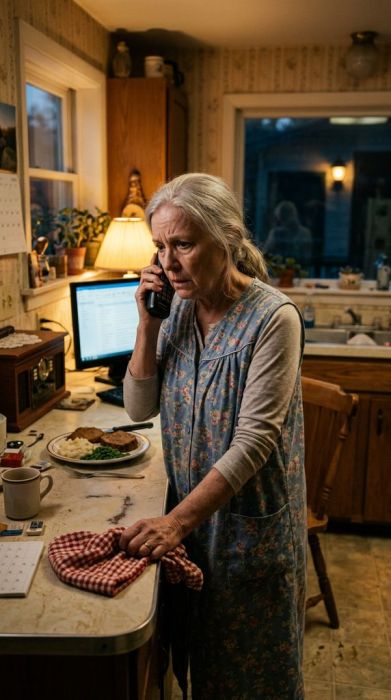
He argued. He pushed past me back toward his waggling car, and then, when I wouldn't hand over anything, he spent a whole hour on the phone calling me a fool and a betrayer. He said I was ruining a family, that Ruth would never speak to me again, that neighbors would stop trusting my flour. He told me smaller things meant to cut. When that didn't crack me, he would try the opposite. He offered to buy half of the recipes. Then he threatened to call a lawyer in three states. Then he balanced and cut between anger and begging, all of it running out of him in the same missing place.
That Saturday gave way to Sunday, and Sunday was the county small businesses fair. The whole town lined the main street under striped awnings. Russell was set to cut the ribbon on the second "Hale & Hearty" in his new chain of banners, and the flyers were printed with a little sketch of a pecan pie and Mama's name smiling right out of them. He was bent low over the scissors, holding the crowd, when I walked up with a microphone and a single piece of paper.
"Russell." My voice carried the whole street. "You have been taking my mother's name, her recipe, and my key for almost a year. But you never once read the page she left, because you never once believed I was smart enough to carry it for you. She left the rights to this name to me. I hold trademark, the recipe, the state secret, and a notarized note done before she could. So enjoy your ribbon. But the sign is already mine—and you built your shop on borrowed brick."
The pause that followed was the longest let go of my life. Then the town did something that near brought me to my knees. It started to clap. Not for Russell, his ribbon, or his banner. But for the daughter, still standing in the shop she'd sweated for. A whole street full of the exact people Mama had fed for fifty years, and they folded over to my counter when I opened the doors and placed one hot thousand on the glass.
The lawyers took over after that. Russell had no mark, no name, no right, and no deed. He closed both shops before the holiday. Ruth left him, came back to Whistling Hill with the tiny bit of courage I helped her find again, and stood beside me at the counter studying—at fifty-four, with flour down her apron—how to braid a crust.
Today the bakery is mine under Mama's name, and it is still her name on the tin. Russell sends pointed letters from or from an address nobody cares to open. And every single morning, when I lift the old shade off the windows and see the hollow sign of "Hale & Hearty" pulled down to bare brick, I run my thumb along the folded page I keep in my drawer sleeve. My mother was guarding a recipe, yes. But she was also guarding me. She knew that the people who take the loud things are the ones most likely to miss, and that the quiet river with a steady bottom, is patient as any flood—kind, when it lets you keep the crest, and old, when it finally arrives.